Within Roswell
The Later Balloon Mishap Behind Some Claims
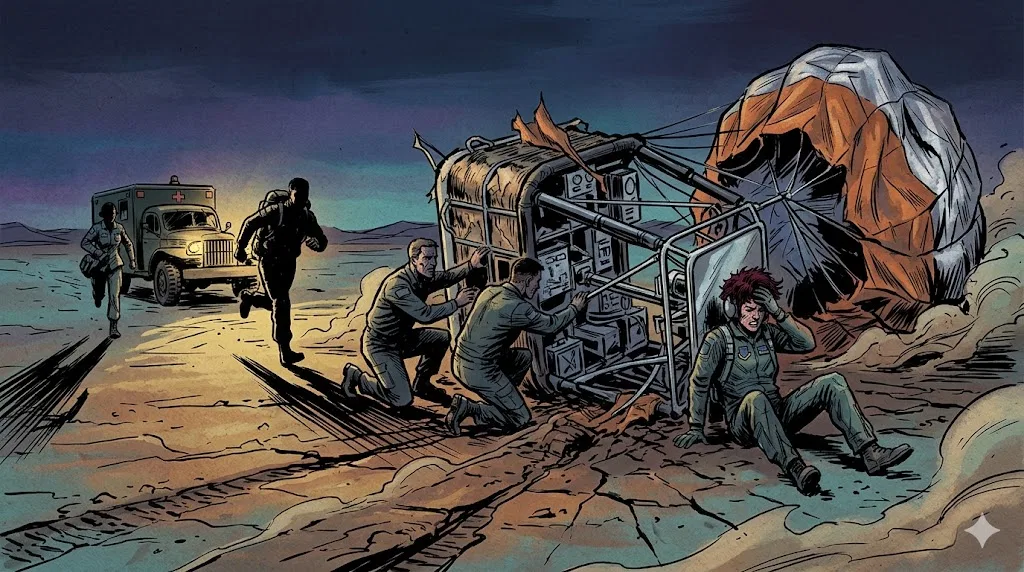
A later manned balloon mishap became part of the official attempt to explain medical and body-related Roswell claims.
On this page
- What the mishap involved
- Why it matters to Roswell testimony
- Where the explanation remains contested
Page outline Jump by section
Introduction
The 1959 balloon mishap matters to Roswell because it is one of the Air Force’s strongest explanations for a very specific part of the later legend: stories of odd-looking bodies, hospital activity, wreckage in ambulances, and a red-haired officer warning people not to talk. It was not the 1947 debris recovery itself. It happened twelve years later, on 21 May 1959, during a manned balloon training flight north-west of Roswell, when Captains Joseph Kittinger, Dan Fulgham and William Kaufman crash-landed in a gondola and two of them were injured. The Air Force later argued that some witnesses had folded memories of this real 1959 incident into Roswell body narratives told decades after 1947. That explanation is plausible for some hospital-centred claims, but contested because it requires memory compression across years, places and separate incidents.[af.mil]af.milU.S. Air ForceThe Roswell Report…
What the mishap involved
The 1959 event came out of the Air Force’s high-altitude balloon and parachute research, not a UFO recovery. By the late 1950s, the Air Force was using balloons to study survival, escape and free-fall problems at altitudes that jet aircraft and early spaceflight were beginning to make urgent. Project Excelsior, associated with Joseph Kittinger, tested parachute systems for pilots forced to escape from aircraft at extreme altitude. The National Museum of the United States Air Force describes Excelsior as a programme that successfully tested parachutes for escaping from very high-flying aircraft, with Kittinger later making three jumps from a balloon gondola in 1959–60, the highest from more than 102,000 feet.[Air Force Museum]nationalmuseum.af.milExcelsior Gondola > National Museum of the United States Air Force > Display…
The mishap itself was not one of Kittinger’s famous stratospheric jumps. It was a low-altitude training flight. According to the Air Force’s 1997 Roswell follow-up report, Colonel John P. Stapp wanted backup balloon pilots because Kittinger was one of very few people with such experience and the programme could be endangered if he were injured. Captains Dan D. Fulgham and William C. Kaufman, both pilots, parachutists and research officers from Wright-Patterson Air Force Base, were sent to Holloman Air Force Base in New Mexico for training.[Project Gutenberg]gutenberg.orgThe Roswell Report: Case Closed, by James McAndrew—A Project Gutenberg eBook…
The flights were closely monitored because balloon training had already produced serious injuries. A helicopter with medical personnel followed in daylight, a C-131 aircraft followed during darkness, and ground teams followed in an ambulance, communications vehicle and recovery vehicle. The 21 May 1959 flight launched at 2:41 a.m. from Holloman Air Force Base. Near the end of the training mission, while practising landing techniques, the gondola overturned about 10 miles north-west of Roswell.[Project Gutenberg]gutenberg.orgThe Roswell Report: Case Closed, by James McAndrew—A Project Gutenberg eBook…
Fulgham later gave a sworn statement saying that the crew were practising touch-and-go landings when the gondola flipped and pinned his head to the ground. He noticed his head swelling under his helmet; Kittinger was bleeding from a facial cut. Fulgham recalled being flown by chase helicopter to Walker Air Force Base, the former Roswell Army Air Field, where he walked into the hospital and stopped on the front step to smoke a cigarette before treatment.[Project Gutenberg]gutenberg.orgThe Roswell Report: Case Closed, by James McAndrew—A Project Gutenberg eBook…
The medical detail is central to why the incident later became important. Fulgham’s clinical record described an extensive forehead and scalp haematoma, meaning a blood-filled swelling. The Air Force report says his eyes swelled shut, his face discoloured, and his nose became barely visible. Kittinger described his appearance as grotesque; Fulgham remembered not realising how bad he looked.[Project Gutenberg]gutenberg.orgThe Roswell Report: Case Closed, by James McAndrew—A Project Gutenberg eBook…
Why it matters to Roswell testimony
The 1959 mishap became important because the best-known Roswell body stories were not part of the original 1947 newspaper cycle. The original public dispute was about debris: a “flying disc” announcement followed by a balloon explanation. The richer body narratives emerged much later, especially after Roswell was revived by UFO researchers from the late 1970s onward. The Air Force’s 1997 report argued that many claims of bodies were not simple fabrications, but confused or blended memories of real Air Force activities in New Mexico between the late 1940s and late 1950s.[Project Gutenberg]gutenberg.orgThe Roswell Report: Case Closed, by James McAndrew—A Project Gutenberg eBook…
The 1959 accident offered a concrete match for several hospital-centred motifs. The Air Force specifically compared it with claims involving a red-haired captain, tight security at the hospital, unusual wreckage in an ambulance, and an “alien” or odd body seen near the hospital. Its argument was not that Fulgham explained every Roswell alien-body claim, but that this later mishap could explain some of the most vivid details attached to the Walker Air Force Base hospital strand of the story.[Project Gutenberg]gutenberg.orgThe Roswell Report: Case Closed, by James McAndrew—A Project Gutenberg eBook…
The red-haired officer detail is one example. In some Roswell accounts, a red-haired captain appears as an intimidating military figure. The Air Force identified the likely real counterpart as Joseph Kittinger, who had red hair and was at Walker hospital after the balloon crash. Kittinger wanted to leave quickly, according to the report, because an accident investigation could have drawn unwelcome attention to Project Excelsior and possibly delayed or threatened the programme. The report accepts that his urgency could have looked secretive to an uninformed observer, but says Kittinger and others denied that he threatened civilians.[Project Gutenberg]gutenberg.orgThe Roswell Report: Case Closed, by James McAndrew—A Project Gutenberg eBook…
The ambulance and “wreckage” details also fitted the balloon-recovery setting better than a spacecraft-recovery setting. The recovery teams used Dodge field ambulances and a utility vehicle; one ambulance had been converted into a communications vehicle. The Air Force argued that a quick view into this vehicle could account for later descriptions of strange blue-purple “wreckage” and markings interpreted as “hieroglyphics”. In its reconstruction, these were probably blue-painted steel panels and ordinary stencilled lettering inside a modified Air Force ambulance.[Project Gutenberg]gutenberg.orgThe Roswell Report: Case Closed, by James McAndrew—A Project Gutenberg eBook…
Most memorably, the accident offered a mundane explanation for at least one “large-headed creature” memory. The Air Force did not claim that Fulgham was dead, hidden or treated like an alien body. Quite the opposite: its report says he was visible at the hospital, waited in a hallway, and was seen by people present for ordinary medical reasons, including military wives attending prenatal care. The point is that a badly swollen, bandaged, discoloured airman walking or sitting in a hospital corridor could later be misremembered, retold or fused with alien-body imagery.[Project Gutenberg]gutenberg.orgThe Roswell Report: Case Closed, by James McAndrew—A Project Gutenberg eBook…
A later retelling of the Roswell reports by the U.S. National Archives makes the same narrow point: Fulgham’s 1959 injury caused serious swelling and facial discoloration, and some people believe stories of the 1947 Roswell incident and the injured men from the 1959 accident became confused over time.[The Unwritten Record]unwritten-record.blogs.archives.govOpen source on archives.gov.
The hospital connection and Glenn Dennis
The 1959 mishap is most often discussed in relation to Glenn Dennis, the Roswell mortician whose account became one of the most influential body-and-autopsy strands of the Roswell story. Dennis claimed to have been at or near the Roswell base hospital in July 1947 and to have encountered strange military activity linked to small bodies. The Air Force report treated his story as a likely composite of several later events, including the 1956 KC-97 crash and the 1959 balloon accident.[Project Gutenberg]gutenberg.orgThe Roswell Report: Case Closed, by James McAndrew—A Project Gutenberg eBook…
The Air Force’s reconstruction divides the Dennis-style material into parts. Burned, mangled bodies and autopsy details were linked more closely to a 1956 KC-97 aircraft crash near Walker Air Force Base, in which 11 Air Force personnel died and three autopsies were performed at Ballard Funeral Home in Roswell. The large-headed, living or injured figure at the hospital was linked more closely to Fulgham after the 1959 balloon mishap.[Project Gutenberg]gutenberg.orgThe Roswell Report: Case Closed, by James McAndrew—A Project Gutenberg eBook…
This matters because Roswell body testimony is often remembered as one dramatic scene: alien bodies, hospital secrecy, autopsies, intimidating officers and unusual debris. The official explanation works by separating that scene back into ordinary incidents: a 1947 balloon-debris recovery, 1950s anthropomorphic dummy drops, a fatal 1956 aircraft crash, and the 1959 manned balloon mishap. The Air Force’s executive summary stated that activities over many years had been “consolidated” into events said to have occurred in two or three days in July 1947.[U.S. Air Force]af.milThe Roswell Report…
That does not make every detail automatically solved. It does, however, change the question. Instead of asking only whether a witness was lying or telling the literal truth, the 1959 mishap raises a third possibility: a witness may have encountered something real, striking and military, but placed it in the wrong year or interpreted it through a Roswell frame that became dominant later.
What memory blending would have to do
For the 1959 explanation to work, memory has to do several things at once. It has to preserve memorable fragments — a crash, an ambulance, a hospital, an injured or strange-looking figure, a red-haired officer, a sense of secrecy — while moving them into the symbolic centre of Roswell: July 1947. That may sound like a large shift, but it is not absurd in a case where many witnesses were interviewed decades later, often after books, television programmes and local Roswell tourism had given the story a familiar narrative shape.
The official record gives the 1959 incident strong anchors: named participants, a date, a location, medical records, sworn statements, vehicle descriptions, and a reason for why the crew might have wanted to minimise publicity. Dr Charles A. Coltman, the Walker flight surgeon, stated that he remembered the balloon crash north of Roswell, the overturned gondola, the injured pilots, the haematoma, and Stapp’s desire to have them returned to Holloman quickly. He also said he recalled no UFO or “space alien” involvement at the hospital.[Project Gutenberg]gutenberg.orgThe Roswell Report: Case Closed, by James McAndrew—A Project Gutenberg eBook…
Fulgham’s own statement strengthens the mundane core of the episode. He described the crash, the swelling, the helicopter trip to Walker, the security personnel checking who the crew were, the treatment, the later hospital stay at Holloman, and the flight back to Wright-Patterson. His wife’s shock on seeing his swollen and discoloured face is exactly the kind of human detail that helps explain why the incident could survive in memory.[Project Gutenberg]gutenberg.orgThe Roswell Report: Case Closed, by James McAndrew—A Project Gutenberg eBook…
The Air Force’s interpretation also fits the broader setting of New Mexico balloon work. White Sands, Holloman and nearby desert areas were used for high-altitude research, dummy drops and aerospace medicine projects. Kittinger’s later Excelsior jumps were not fringe experiments; they contributed to high-altitude escape knowledge at a moment when the X-15, Project Mercury and the edge of space were becoming practical engineering problems.[Air Force Museum]nationalmuseum.af.milExcelsior Gondola > National Museum of the United States Air Force > Display…
Where the explanation remains contested
The strongest objection is chronological: Roswell’s alleged crash happened in 1947, while the Fulgham-Kittinger-Kaufman mishap happened on 21 May 1959. Critics argue that an explanation requiring a twelve-year displacement cannot be treated as a clean debunking of all body testimony. Even sympathetic summaries of the official position acknowledge the gap: the balloon mishap can explain certain later hospital stories only if witnesses or storytellers compressed separate events into the Roswell timeline.[Air & Space Forces Association]secure.afa.orgOpen source on afa.org.
A second limitation is scope. The 1959 mishap is not an explanation for the original debris field, the 8 July 1947 press release, or every later tale of bodies in the desert. It is a targeted explanation for a subset of memories: hospital scenes, odd-looking injured airmen, emergency vehicles, a red-haired officer and the impression of secrecy. Treating it as a universal answer overstates what the evidence can bear.
A third difficulty is that the Air Force was investigating a story that had already become culturally and commercially powerful. By the 1990s, Roswell was no longer just an archival question. It had become a UFO landmark, a media subject and a tourism identity. Air & Space Forces Magazine noted that Roswell’s alien imagery and museum culture had become part of the town’s public identity, which made later accounts harder to separate from the story-world built around them.[Air & Space Forces Magazine]airandspaceforces.comAir & Space Forces Magazine USAF and the UFOs | Air & Space Forces MagazineAir & Space Forces Magazine USAF and the UFOs | Air & Space Forces Magazine
There is also a trust problem. The government’s original 1947 explanation did change quickly, and later official accounts acknowledged that the recovered debris was linked to Project Mogul rather than an ordinary weather balloon. The GAO’s 1995 records search found only two 1947 government records directly concerning Roswell and noted that some Roswell Army Air Field administrative records and outgoing messages had been destroyed without clear documentation of when or under what authority. That does not prove an alien recovery, but it helps explain why official explanations were received sceptically by some readers.[FAS Project on Government Secrecy]sgp.fas.orgProject on Government Secrecy GAO Report on Roswell, NM UFO CrashProject on Government Secrecy GAO Report on Roswell, NM UFO Crash
The best reading of the 1959 mishap
The 1959 balloon mishap is best understood as a partial, evidence-rich explanation for why some Roswell body stories sound the way they do. It does not erase the original 1947 incident, and it does not require assuming that every witness acted in bad faith. Its value is more precise: it shows how a real military balloon accident near Roswell, involving recognisable personnel, a swollen and discoloured pilot, hospital treatment, ambulances and a desire to avoid publicity, could supply raw material for later memories of strange bodies and secrecy.
That makes the mishap one of the most important “memory sources” in the official Roswell explanation. The Air Force case is strongest where it can line up named people, documents and physical circumstances: Fulgham’s haematoma, Kittinger’s presence, the Walker hospital visit, the recovery vehicles, and the later transfer to Wright-Patterson. It is weaker if stretched into a complete explanation for every Roswell body claim or used to dismiss all witness testimony without examining which details actually match.
The useful conclusion is therefore neither “the 1959 mishap explains Roswell” nor “the 1959 mishap is irrelevant”. It explains why some of the most vivid later Roswell memories may belong to the Cold War balloon-and-aerospace world of the 1950s rather than to the debris recovery of July 1947. Its importance lies in showing how Roswell became a layered case: one real 1947 recovery, later military incidents in the same region, and decades of memory, media and interpretation gradually fused into a single enduring story.
Amazon book picks
Further Reading
Books and field guides related to The Later Balloon Mishap Behind Some Claims. Use these as the next step if you want deeper reading beyond the article.
The Roswell Report: Case Closed
Directly relevant because the Air Force used events including the 1959 balloon mishap to explain later body-recovery stories and witness...
UFO Crash at Roswell
Provides the core witness-based Roswell narrative against which later explanations such as the 1959 balloon mishap are compared.
The Day After Roswell
Represents the influential pro-Roswell perspective that contrasts sharply with Air Force explanations such as the 1959 incident.
Roswell Incident
Essential background for understanding how Roswell legends developed and why later explanatory theories became important.
eBay marketplace picks
Marketplace Samples
Live-tested eBay searches with available results related to this page.


Endnotes
1.
Source: af.mil
Title: U.S. Air Force
Link:https://www.af.mil/The-Roswell-Report/
Source snippet
The Roswell Report...
2.
Source: gutenberg.org
Title: Project Gutenberg
Link:https://www.gutenberg.org/files/63659/63659-h/63659-h.htm
Source snippet
The Roswell Report: [Case Closed]({{ 'case-closed/' | relative_url }}), by James McAndrew—A Project Gutenberg eBook...
3.
Source: nationalmuseum.af.mil
Title: Air Force Museum
Link:https://www.nationalmuseum.af.mil/Visit/Museum-Exhibits/Fact-Sheets/Display/Article/195681/excelsior-gondola/
Source snippet
Excelsior Gondola > National Museum of the United States Air Force > Display...
4.
Source: unwritten-record.blogs.archives.gov
Link:https://unwritten-record.blogs.archives.gov/2014/07/07/the-roswell-reports-what-crashed-in-the-desert/
5.
Source: sgp.fas.org
Title: Project on Government Secrecy GAO Report on Roswell, NM UFO Crash
Link:https://sgp.fas.org/othergov/roswell.html
6.
Source: time.com
Title: aliens or [dummies]({{ ‘dummies/’ | relative_url }})
Link:https://time.com/archive/6930414/aliens-or-dummies/
7.
Source: airandspaceforces.com
Title: Air & Space Forces Magazine USAF and the UFOs | Air & Space Forces Magazine
Link:https://www.airandspaceforces.com/article/0611ufo/
8.
Source: secure.afa.org
Link:https://secure.afa.org/joinafa/AFMag2014/AFMag1014/files/basic-html/page10.html
9.
Source: Wikipedia
Title: Roswell incident
Link:https://en.wikipedia.org/wiki/Roswell_incident
10.
Source: Wikipedia
Title: Project Excelsior
Link:https://en.wikipedia.org/wiki/Project_Excelsior
11.
Source: jhmovie.fandom.com
Title: Roswell incident
Link:https://jhmovie.fandom.com/wiki/Roswell_incident
12.
Source: history.com
Title: U.S. Air Force reports on Roswell
Link:https://www.history.com/this-day-in-history/june-24/u-s-air-force-reports-on-roswell
13.
Source: coffeeordie.com
Title: joseph kittinger
Link:https://www.coffeeordie.com/article/joseph-kittinger
14.
Source: spaceflighthistories.com
Title: project excelsior
Link:https://www.spaceflighthistories.com/post/project-excelsior
15.
Source: muller.lbl.gov
Title: Roswell Incident
Link:https://muller.lbl.gov/teaching/physics10/Roswell/RoswellIncident.html
16.
Source: britannica.com
Title: Roswell incident
Link:https://www.britannica.com/event/Roswell-incident
Additional References
17.
Source: youtube.com
Link:https://www.youtube.com/watch?v=Bl-5F5bbEwQ
Source snippet
"Roswell Report" OR "Roswell" Joe Kittinger balloon 1959 Joseph Kittinger Record Breaking Sky Dive From The Edge Of Space 102800 ft 1960...
18.
Source: youtube.com
Title: Reel America: “The Roswell Reports”
Link:https://www.youtube.com/watch?v=m7rVSri-7es
Source snippet
The Roswell Report: Case Closed by James McAndrew read by Aaron Bennett | Full Audio Book...
19.
Source: nro.gov
Link:https://www.nro.gov/Portals/65/documents/history/csnr/corona/StarCatchersWeb.pdf
20.
Source: govinfo.gov
Link:https://www.govinfo.gov/content/pkg/GOVPUB-D5_400-PURL-gpo124/pdf/GOVPUB-D5_400-PURL-gpo124.pdf
21.
Source: govinfo.gov
Link:https://www.govinfo.gov/content/pkg/GOVPUB-D301-PURL-gpo92195/pdf/GOVPUB-D301-PURL-gpo92195.pdf
22.
Source: youtube.com
Link:https://www.youtube.com/watch?v=ivaWnbKsBkM
Source snippet
1947 🇺🇸 #UFOB [CASE] The 'final' Airforce report on Roswell. 1997 press conference...
23.
Source: youtube.com
Link:https://www.youtube.com/watch?v=MfFx24lLiI4
Source snippet
W. Glenn Dennis Interview, 11/19/1990...
24.
Source: spokesman.com
Link:https://www.spokesman.com/stories/1997/jun/25/dummies-tell-no-tales-air-force-tries-to-close/
25.
Source: facebook.com
Link:https://www.facebook.com/groups/spacehipsters/posts/8096320837079395/
26.
Source: amazon.com
Link:https://www.amazon.com/Roswell-Incident-Statements-Excelsior-Experiments-ebook/dp/B005F9YCL4
Topic Tree
Follow this branch
Parent topic
RoswellRelated pages 29
- Ambulance Clues Were Roswell Hieroglyphics Inside an Ambulance?
- Crash Link Did a 1959 Crash Feed Roswell Body Stories?
- Dennis Composite Was Glenn Dennis Remembering More Than One Event?
- Fulgham Injury Could an Injured Airman Look Like an Alien?
- Hospital Dates Can Roswell Witnesses Misplace Twelve Years?
- +1 more in sidebar