Within Roswell
Can the Ramey Memo Prove Anything?
The Ramey memo remains a contested document because readers disagree about what its blurred text says.
On this page
- Why the memo matters
- Competing readings
- Limits of blurry document evidence
Page outline Jump by section
Introduction
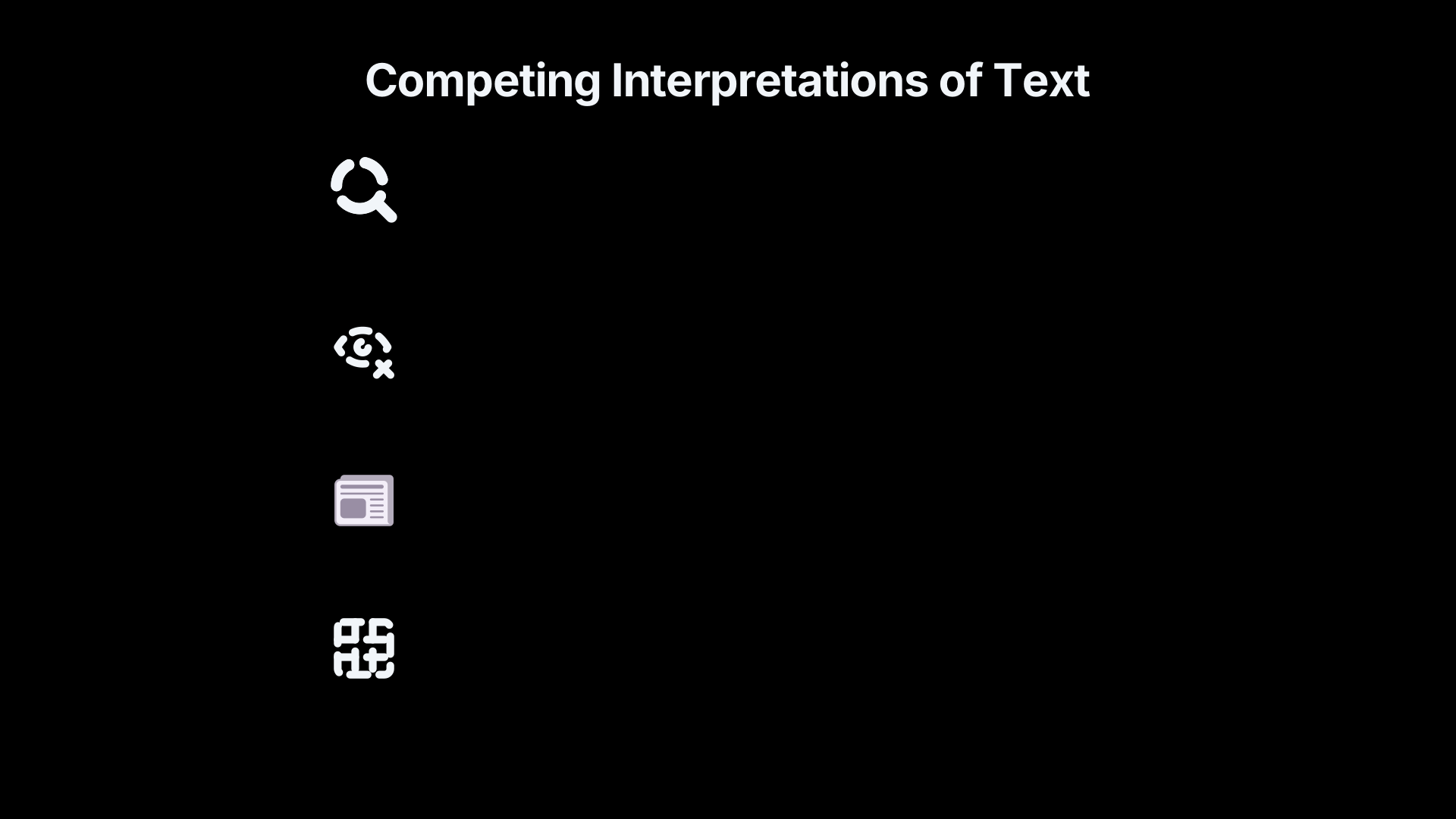
The Ramey memo is one of the most argued-over pieces of Roswell evidence because it looks tantalisingly close to readable but remains too blurred for a settled transcription. It appears in a 1947 photograph of Brigadier General Roger M. Ramey, taken in Fort Worth as he displayed debris that the Army identified as a weather balloon or radar target. In Ramey’s hand is a paper with faint lines of text. Some Roswell researchers argue that enhanced images reveal phrases such as “victims of the wreck” and “disc”; sceptics argue that those readings are products of expectation, selective enhancement, and the human habit of finding words in ambiguous marks. The memo matters, then, less as a clean document than as a test of how far photographic evidence can be stretched before interpretation becomes projection.[Wikimedia Commons]commons.wikimedia.orgCommons File:General Ramey with Roswell Memo.pngCommons File:General Ramey with Roswell Memo.png
Why the memo matters
The Ramey memo has unusual appeal because, unlike many later Roswell claims, it is attached to a real contemporary photograph. The image is not a late witness recollection or a second-hand story from decades after the event; it is a news photograph associated with J. Bond Johnson and the Fort Worth Star-Telegram, showing Ramey with Roswell debris and a visible document in his hand. Wikimedia Commons identifies the source as Johnson’s Fort Worth Star-Telegram photograph, published with the 9 July 1947 story “One Disk Tale Exploded by Army as Others Fly.”[Wikimedia Commons]commons.wikimedia.orgCommons File:General Ramey with Roswell Memo.pngCommons File:General Ramey with Roswell Memo.png
That provenance is the memo’s strongest feature. Roswell debates often suffer from evidence that appeared long after 1947, but the Ramey photograph belongs to the original news cycle. The photograph also sits at the exact pivot point of the Roswell story: the public shift from the Roswell Army Air Field’s “flying disc” announcement to Ramey’s Fort Worth explanation that the material was balloon-related. A document in Ramey’s hand at that moment is naturally attractive to anyone trying to reconstruct what senior officers were saying privately while giving a public explanation.
The catch is that provenance is not the same as legibility. The photograph can establish that Ramey was holding a document, and it can support debate about whether some letters or words are visible. It cannot by itself make a blurred text decisive. The University of Texas at Arlington’s Roswell digital collection has treated the memo as a serious archival object, including high-resolution microfiche scans and high dynamic range imaging, but its own presentation of the material reflects the central difficulty: the evidence is useful because it can be examined, yet still contested because it does not yield a stable reading.[sites.libraries.uta.edu]sites.libraries.uta.eduOpen source on uta.edu.

Competing readings
The pro-Roswell reading is associated especially with David Rudiak and researchers who argue that enhancement makes key phrases visible. Rudiak’s “Roswell Proof” material claims the memo contains references to “the victims of the wreck”, “disc”, and something being shipped “in the disc”. A search-indexed summary of his site states that he treats those phrases as proof of a crashed “disc” and recovered bodies, while another Roswell Proof page describes comparison work on disputed line readings such as “the victims of the wreck” and “the ‘disc’”.[roswellproof.com]roswellproof.comOpen source on roswellproof.com.
This is why the memo keeps returning in Roswell discussion. If the phrase “victims of the wreck” were demonstrably present in a message held by Ramey on 8 July 1947, it would sit uneasily with a simple weather-balloon explanation. If the word “disc” appeared in an internal message rather than only in public newspaper language, it would also be significant, though not automatically extraterrestrial: in July 1947, “disc” was already the public shorthand for the wave of flying-saucer reports. The real dispute is not whether such words would matter, but whether the photograph actually supports reading them with enough confidence.
Other readings are more cautious. Some viewers think isolated words such as “weather balloons” or “disc” may be more plausible than the full dramatic phrases. Others accept that a few word-like shapes recur across attempts but reject the leap from fragments to a coherent alien-crash message. Even within Roswell-friendly research, the memo has not produced a universal transcript. Kevin Randle’s later scholarly summary states plainly that attempts to decipher the photographed document “have not provided definitive results that would rule out any explanations”, while still arguing that better scans may remain a useful research path.[PhilPapers]philpapers.orgPhil Papers Kevin Randle, A Grounded Theory Update on the Roswell UFO IncidentPhil Papers Kevin Randle, A Grounded Theory Update on the Roswell UFO Incident
That distinction matters. A partial reading can be interesting without being probative. “Disc” might be present, but a July 1947 press or military communication could use that word while discussing the public story. “Weather balloons” might be present, but that could support either a mundane explanation or, in a more conspiratorial reading, a cover story. “Victims” would be more explosive, but it is also among the most disputed readings because the visual evidence is less stable than the implications attached to it.
Why readers disagree
The Ramey memo is a classic case of document-reading under poor conditions. The object being read is not the original paper on a desk under good light. It is a small, angled, partially exposed document inside a black-and-white press photograph, later enlarged, scanned, cropped, sharpened, and interpreted. Each step can help reveal structure, but each can also create artefacts that resemble letters.
The most important study of this problem is James Houran and Kevin Randle’s 2002 article, “A Message in a Bottle: Confounds in Deciphering the Ramey Memo from the Roswell UFO Case”. The authors gave participants images of the memo under three different suggestion conditions: one group was told it related to Roswell, another that it concerned atomic-bomb testing, and a third received no content cue. Many participants claimed they could read the document, but their solutions tended to follow the suggestions they had been given. The number of words people reported also related to factors such as age, tolerance of ambiguity, and prior exposure to UFO and Roswell material.[ResearchGate]researchgate.netOpen source on researchgate.net.
The study did not simply dismiss the memo. It found that a few words in the same locations were perceived across the different suggestion conditions and matched words identified in earlier investigations. That is a crucial nuance: the memo is not pure visual noise, but neither is it a cleanly readable message. The authors concluded that future research might be informative only if stronger methodological criteria were established.[ResearchGate]researchgate.netOpen source on researchgate.net.
This helps explain why the dispute feels so persistent. People are not merely disagreeing about Roswell; they are disagreeing about how to read uncertainty. One reader sees repeated shapes and thinks the same phrase is emerging from the blur. Another sees the same image and thinks the phrase has been supplied by context. Once a suggested wording is known, it becomes difficult to look at the image “fresh”, because the mind starts matching marks to the phrase it expects.
Limits of blurry document evidence
The Ramey memo can support modest claims better than dramatic ones. It can show that a real document was present in Ramey’s hand during a key Roswell press moment. It can justify archival and imaging work. It can support the claim that some markings may correspond to words. But it struggles to prove a full hidden narrative, because the most consequential readings are exactly the ones that require the most interpretive confidence.
A useful way to test any proposed transcription is to ask three questions:
- Can independent readers find the same words without being prompted? The Houran and Randle experiment suggests that suggestion can shape perceived readings, but also that some recurring word locations may be worth studying further.[ResearchGate]researchgate.netOpen source on researchgate.net.
- Does the proposed reading fit the document’s visible structure, not just isolated shapes? A convincing transcript needs line length, spacing, word order, and repeated letter forms to work together.
- Does the reading explain both helpful and unhelpful fragments? A strong interpretation should not highlight “victims” or “disc” while ignoring possible mundane words such as “weather balloons” if those are also being claimed.
The memo also shows the risk of enhancement as persuasion. Sharpening, contrast adjustment, enlargement, and high dynamic range processing can make faint features easier to inspect, but they do not restore missing information in a magical way. When the source image lacks enough detail, enhancement can make uncertain marks look more definite than they are. That is why the UTA scan project is valuable as an archive, but not automatically a solution to the interpretive dispute.[sites.libraries.uta.edu]sites.libraries.uta.eduOpen source on uta.edu.
The broader Roswell context cuts both ways. Official Air Force research concluded that the recovered material was consistent with a balloon device, most likely connected to Project Mogul, and said it found no records of recovered alien bodies or extraterrestrial materials. That background makes a “victims of the wreck” reading extraordinary and therefore demanding of very strong evidence. At the same time, the official 1947 reversal from “flying disc” to balloon explanation is precisely why many readers remain motivated to scrutinise every contemporary scrap.[NSA]nsa.govOpen source on nsa.gov.
Can the Ramey memo prove anything?
The Ramey memo can prove that Roswell researchers have one unusually concrete item to examine: a contemporary photograph, tied to a named press source, showing a senior officer holding a document during the Fort Worth debris presentation. That is not trivial. In a case filled with memories, rumours, and later testimony, a 1947 image has a different evidential status.[Wikimedia Commons]commons.wikimedia.orgCommons File:General Ramey with Roswell Memo.pngCommons File:General Ramey with Roswell Memo.png
What it cannot yet prove is the claim people most want from it: that Ramey’s document acknowledged alien bodies, a crashed extraterrestrial craft, or a secret recovery operation. The strongest fair assessment is that the memo remains suggestive but not decisive. Pro-Roswell readings identify potentially important words and phrases; sceptical and methodological critiques show that expectation, ambiguity, and image degradation can generate confident but incompatible transcriptions. The most responsible conclusion is not that the memo is worthless, nor that it is a smoking gun. It is a fragile piece of dataset evidence whose value depends on disciplined reading standards.
That is why the Ramey memo remains important within the Roswell UFO crash debate. It shifts the question from “Do you believe the witnesses?” to “What can be recovered from a damaged historical image?” The answer is uncomfortable for both sides: enough to keep the document relevant, but not enough to make it settle Roswell.
eBay marketplace picks
Marketplace Samples
Example marketplace items related to this page. Use the search link to explore similar finds on eBay.
Endnotes
1.
Source: commons.wikimedia.org
Title: Commons File:General Ramey with Roswell Memo.png
Link:https://commons.wikimedia.org/wiki/File%3AGeneral_Ramey_with_Roswell_Memo.png
2.
Source: researchgate.net
Link:https://www.researchgate.net/publication/228706129_A_Message_in_a_Bottle_Confounds_in_Deciphering_the_Ramey_Memo_from_the_Roswell_UFO_Case
3.
Source: sites.libraries.uta.edu
Link:https://sites.libraries.uta.edu/roswell/ramey-memo
4.
Source: roswellproof.com
Link:https://www.roswellproof.com/
5.
Source: roswellproof.com
Link:https://www.roswellproof.com/ramey_memo_compare.html
6.
Source: philpapers.org
Title: Phil Papers Kevin Randle, A Grounded Theory Update on the Roswell UFO Incident
Link:https://philpapers.org/rec/RANAGT-3
7.
Source: nsa.gov
Link:https://www.nsa.gov/portals/75/documents/news-features/declassified-documents/ufo/report_af_roswell.pdf
8.
Source: sites.libraries.uta.edu
Link:https://sites.libraries.uta.edu/roswell/node/21
9.
Source: sites.libraries.uta.edu
Link:https://sites.libraries.uta.edu/roswell/home
10.
Source: researchgate.net
Title: 395734150 Ramey Memo An In Depth Scientifically Based Deep Research Study
Link:https://www.researchgate.net/publication/395734150_Ramey_Memo-An_In_Depth_Scientifically_Based_Deep_Research_Study
11.
Source: researchgate.net
Link:https://www.researchgate.net/profile/James-Houran/publication/228706129_A_Message_in_a_Bottle_Confounds_in_Deciphering_the_Ramey_Memo_from_the_Roswell_UFO_Case/links/0deec527833e585cd6000000/A-Message-in-a-Bottle-Confounds-in-Deciphering-the-Ramey-Memo-from-the-Roswell-UFO-Case.pdf
12.
Source: researchgate.net
Link:https://www.researchgate.net/publication/362854511_A_Grounded_Theory_Update_on_the_Roswell_UFO_Incident
13.
Source: roswellproof.com
Title: Gen. Wesley Clark comments on UFOs
Link:https://www.roswellproof.com/gen_wesley_clark_ufos.html
14.
Source: roswellproof.com
Link:https://www.roswellproof.com/Methods.html
15.
Source: roswellproof.com
Title: General Roger Ramey and UFOs
Link:https://www.roswellproof.com/ramey_and_ufos.html
16.
Source: roswellproof.com
Link:https://www.roswellproof.com/dennis.html
17.
Source: digital.library.adelaide.edu.au
Link:https://digital.library.adelaide.edu.au/dspace/handle/2440/3334
18.
Source: ia601607.us.archive.org
Title: DTIC ADA326148
Link:https://ia601607.us.archive.org/20/items/DTIC_ADA326148/DTIC_ADA326148.pdf
19.
Source: cdn.nationalarchives.gov.uk
Link:https://cdn.nationalarchives.gov.uk/documents/the-ufo-files-extract.pdf
Additional References
20.
Source: youtube.com
Title: The Truth about Roswell: Decoding Decades of Deception
Link:http://www.youtube.com/watch?v=rih9-80p0Ec
Source snippet
Ramey Memo Roswell document reading dispute UFO hearing: Whistleblower says he's witnessed harm by "non-human" entities Global News...
21.
Source: youtube.com
Title: XZBN UFO Files
Link:http://www.youtube.com/watch?v=r3E-nA9NkC8
Source snippet
A Different Perspective with Kevin Randle Interviews - DAVID RUDIAK - Decoding the Ramey Memo...
22.
Source: youtube.com
Title: A Different Perspective with Kevin Randle Interviews
Link:http://www.youtube.com/watch?v=mx5TxFCz5gs
Source snippet
Kevin Randle Interviews - BRENDA McCLURKIN - The Ramey Memo...
23.
Source: youtube.com
Link:https://www.youtube.com/watch?v=6u0F2_k2o4o
Source snippet
The Truth about Roswell: Decoding Decades of Deception...
24.
Source: youtube.com
Title: Kevin Randle Interviews
Link:http://www.youtube.com/watch?v=_IbPcoFpZJo
Source snippet
America's Most Mysterious UFO Cases | Expedition Unknown: Hunt For Extraterrestrials S1E4...
25.
Source: semanticscholar.org
Link:https://www.semanticscholar.org/paper/%22A-message-in-a-bottle%3A%22-Confounds-in-deciphering-Houran-Randle/0a08310d1ace75c161c8fef55cd69c68c89f7859
26.
Source: facebook.com
Link:https://www.facebook.com/groups/canterburyplanespotters/posts/1995233534617165/
27.
Source: reddit.com
Link:https://www.reddit.com/r/UFOs/comments/1ij460d/i_transcripted_the_ramey_memo/
28.
Source: academia.edu
Link:https://www.academia.edu/144097753/Rameys_Memo_An_In_Depth_Scientifically_Based_Deep_Research_Study
29.
Source: academia.edu
Link:https://www.academia.edu/4003190/The_Most_Comprehensive_Account_of_the_Roswell_Incident_You_Ever_Did_See
Topic Tree