Within KC 97
Inside the Walker AFB Body Identification Trail
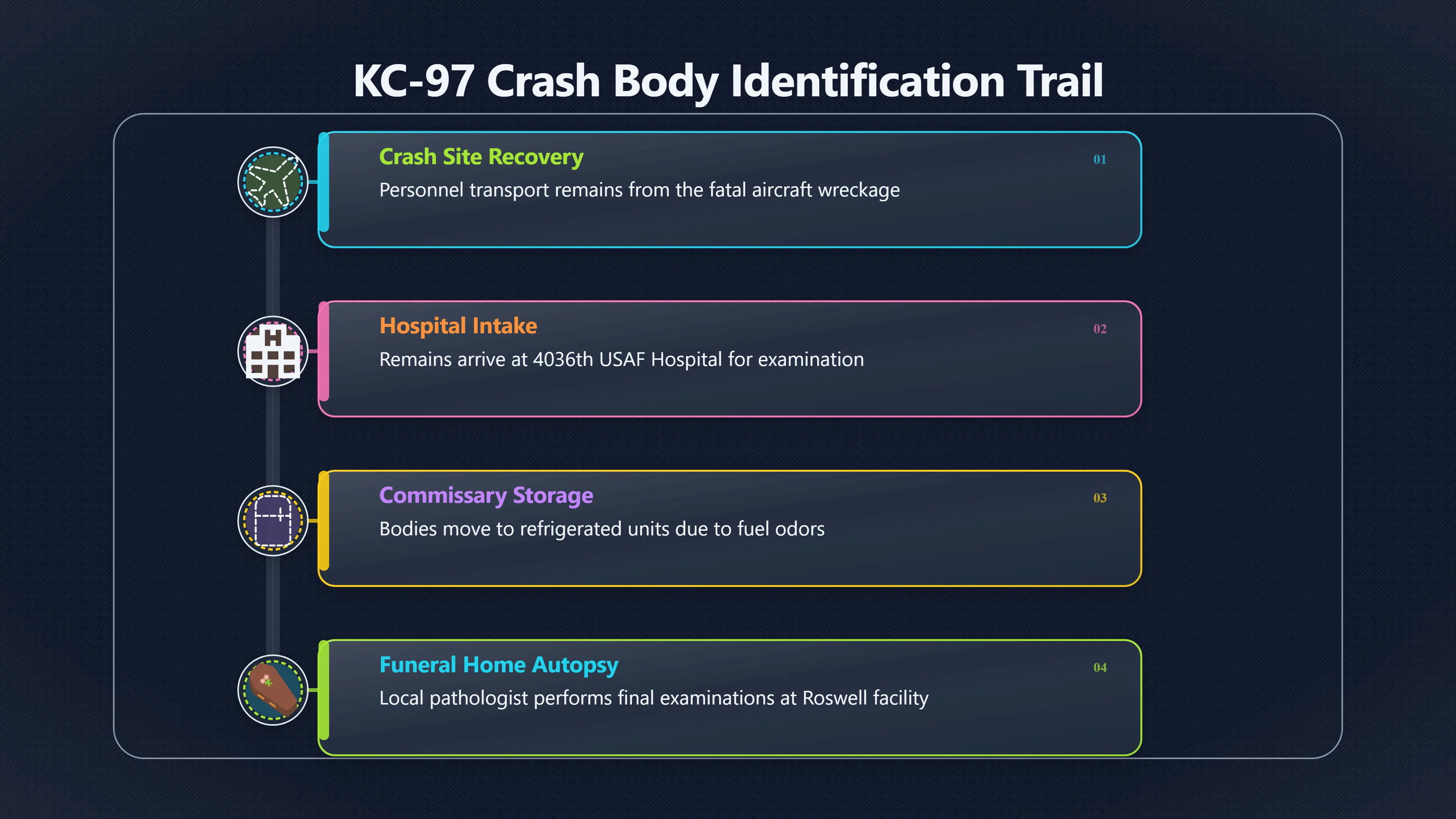
The route from crash site to base hospital, commissary refrigeration, and funeral-home autopsies is the official report's strongest documented trail.
On this page
- Why the remains went to the base hospital
- Why identification moved to refrigerated storage
- How the trail ended at a Roswell funeral home
Page outline Jump by section
Introduction
Among the many Roswell body narratives that emerged decades after 1947, the most thoroughly documented chain involving actual human remains does not begin with a flying saucer claim at all. It begins with the aftermath of the fatal KC-97 tanker crash near Walker Air Force Base on 26 June 1956. According to military records examined during the U.S. Air Force’s Roswell investigation, the recovery and identification process followed a traceable route: remains were taken from the crash site to the Walker AFB hospital, identification work was shifted to refrigerated storage in the base commissary, and several autopsies were conducted at a Roswell funeral home. This sequence became important because many later Roswell body stories were set in hospitals, morgues, and medical facilities and contained details that overlapped with the documented handling of crash victims.[gutenberg.org]gutenberg.org63659 hProject GutenbergThe Roswell Report: Case Closed, by James McAndrew—…KC-97 Aircraft. 8. 4036th USAF Hospital, Walker AFB, N.M., 1956…
 Rather than addressing the broader Roswell debris controversy, the hospital trail focuses on a narrower question: what can be established about the movement and identification of bodies after the 1956 disaster, and why did that process later become relevant to claims about recovered non-human bodies?
Why the remains went to the base hospital
The KC-97G Stratofreighter crashed approximately 8.8 miles south of Walker Air Force Base after a catastrophic propeller failure that triggered a severe onboard fire. All eleven crew members were killed. Recovery personnel transported the remains from the crash scene to the 4036th USAF Hospital at Walker AFB, the installation’s medical facility, where identification efforts began.[Project Gutenberg]gutenberg.org63659 hProject GutenbergThe Roswell Report: Case Closed, by James McAndrew—…KC-97 Aircraft. 8. 4036th USAF Hospital, Walker AFB, N.M., 1956…
From a practical standpoint, the hospital was the logical first destination. The victims had to be accounted for, examined, documented, and identified before their remains could be released to families. Air Force records cited in The Roswell Report: Case Closed indicate that hospital personnel participated directly in this process. An identification specialist from Wright-Patterson Air Force Base arrived the following day to assist with the difficult task of determining who was who among severely damaged remains.[Project Gutenberg]gutenberg.org63659 hProject GutenbergThe Roswell Report: Case Closed, by James McAndrew—…KC-97 Aircraft. 8. 4036th USAF Hospital, Walker AFB, N.M., 1956…
This detail matters because many later Roswell witnesses described unusual activity at a military hospital. The documented 1956 response demonstrates that the Walker hospital genuinely did become the centre of a major body-identification operation involving outside specialists, restricted access, and intensive medical work. The existence of such an event provides a verifiable source for memories of extraordinary activity at the base medical facility, regardless of whether one accepts the Air Force’s broader explanation of Roswell body stories.[Project Gutenberg]gutenberg.org63659 hProject GutenbergThe Roswell Report: Case Closed, by James McAndrew—…KC-97 Aircraft. 8. 4036th USAF Hospital, Walker AFB, N.M., 1956…
Why identification moved to refrigerated storage
One of the most distinctive features of the documented trail is that the identification effort did not remain in the hospital.
According to Air Force records, investigators encountered a practical problem. The remains had been subjected to intense fire and were saturated with fuel. The resulting odour became overwhelming, and the relatively small hospital lacked suitable facilities for prolonged storage and examination. As a result, identification activities were transferred from the hospital to a refrigerated compartment inside the Walker AFB commissary.[Project Gutenberg]gutenberg.org63659 hProject GutenbergThe Roswell Report: Case Closed, by James McAndrew—…KC-97 Aircraft. 8. 4036th USAF Hospital, Walker AFB, N.M., 1956…
This move is significant for two reasons.
First, it reflects the realities of military disaster management during the 1950s. Modern mortuary facilities with specialised disaster-response capabilities were not available at every installation. Refrigeration slowed decomposition and created a more workable environment for identification specialists. The commissary’s cold-storage area therefore became a temporary substitute for facilities the hospital did not possess.[Project Gutenberg]gutenberg.org63659 hProject GutenbergThe Roswell Report: Case Closed, by James McAndrew—…KC-97 Aircraft. 8. 4036th USAF Hospital, Walker AFB, N.M., 1956…
Second, the unusual relocation helps explain why memories of the event could later become fragmented. Bodies were associated not only with a hospital but also with another building on the base. Individuals who encountered different stages of the process might remember refrigerated rooms, restricted areas, military guards, or unusual transportation of remains without necessarily understanding the larger context. The Air Force investigation highlighted precisely this chain of events when assessing later claims involving mysterious bodies and medical facilities at Roswell.[Project Gutenberg]gutenberg.org63659 hProject GutenbergThe Roswell Report: Case Closed, by James McAndrew—…KC-97 Aircraft. 8. 4036th USAF Hospital, Walker AFB, N.M., 1956…
The commissary stage is one of the strongest documented elements in the entire body-identification trail because it derives from specific Air Force records concerning the handling of the KC-97 victims rather than from retrospective witness recollections alone.[Project Gutenberg]gutenberg.org63659 hProject GutenbergThe Roswell Report: Case Closed, by James McAndrew—…KC-97 Aircraft. 8. 4036th USAF Hospital, Walker AFB, N.M., 1956…
How the trail ended at a Roswell funeral home
The final stage moved beyond the base itself.
Air Force records state that on 27 June 1956, a local Roswell pathologist performed autopsies on three of the crash victims. These examinations did not occur at Walker AFB. They were conducted at a local funeral home in Roswell. After identification and post-mortem procedures were completed, the remains were released for shipment to next of kin and burial.[Project Gutenberg]gutenberg.org63659 hProject GutenbergThe Roswell Report: Case Closed, by James McAndrew—…KC-97 Aircraft. 8. 4036th USAF Hospital, Walker AFB, N.M., 1956…
The funeral-home connection became especially important in later Roswell discussions because one of the most widely cited body witnesses was mortician Glenn Dennis, who worked at Ballard Funeral Home and later claimed knowledge of unusual bodies associated with the 1947 incident. Air Force investigators noted that the 1956 KC-97 disaster produced documented funeral-home involvement, including autopsies conducted there, creating a potential historical source for memories involving body examinations in Roswell mortuary settings.[airandspaceforces.com]airandspaceforces.comAir & Space Forces Magazine USAF and the UFOsformerly Roswell AAF). AFB, N.M. The autopsy of three of the casualties was performed at Ballard. Funeral Home…Read more…
Critics and supporters of the Roswell extraterrestrial interpretation disagree sharply about how much explanatory weight should be given to this connection. Nevertheless, the underlying facts are comparatively well documented: bodies from the KC-97 crash entered a chain that extended from the crash site to the base hospital, then to refrigerated commissary storage, and finally to a Roswell funeral home where autopsies were performed.[Project Gutenberg]gutenberg.org63659 hProject GutenbergThe Roswell Report: Case Closed, by James McAndrew—…KC-97 Aircraft. 8. 4036th USAF Hospital, Walker AFB, N.M., 1956…
Why this trail became central to the body-story debate
The importance of the Walker AFB hospital trail lies less in what it proves than in what it documents.
Many Roswell body narratives involve recurring themes:
- Burned or badly damaged bodies.
- Medical personnel working under unusual conditions.
- Temporary storage of remains.
- Outside specialists arriving to assist.
- Autopsies performed away from the main military facility.
- Restricted access to medical areas.
The 1956 KC-97 response contains all of these elements in a verifiable historical event. Air Force investigators therefore argued that memories of this disaster could have become blended with other experiences and stories over time, eventually contributing to accounts of alien bodies at Roswell.[gutenberg.org]gutenberg.org63659 hProject GutenbergThe Roswell Report: Case Closed, by James McAndrew—…KC-97 Aircraft. 8. 4036th USAF Hospital, Walker AFB, N.M., 1956…
Whether one accepts that interpretation or not, the hospital-to-commissary-to-funeral-home sequence remains one of the clearest documentary trails connected to Roswell body claims. Unlike many elements of the wider controversy, it is anchored in military records, hospital involvement, identification reports, and documented post-mortem procedures. For that reason, the Walker AFB body-identification trail occupies a central place in any examination of how Roswell body stories developed and why medical settings became such a persistent feature of the legend.[gutenberg.org]gutenberg.org63659 hProject GutenbergThe Roswell Report: Case Closed, by James McAndrew—…KC-97 Aircraft. 8. 4036th USAF Hospital, Walker AFB, N.M., 1956…

Amazon book picks
Further Reading
Books and field guides related to Inside the Walker AFB Body-Identification Trail. Use these as the next step if you want deeper reading beyond the article.
Witness to Roswell
Covers hospital, mortuary, and body-handling claims from witnesses.
UFO Crash at Roswell
Useful for understanding how hospital stories became embedded in the myth.
The Roswell Report: Case Closed
Details the movement of remains, autopsies, and the Walker AFB connection.

Roswell Incident
Foundational source for the broader body-and-hospital narrative tradition.
eBay marketplace picks
Marketplace Samples
Live-tested eBay searches with available results related to this page.




Endnotes
1.
Source: gutenberg.org
Title: 63659 h
Link:https://www.gutenberg.org/files/63659/63659-h/63659-h.htm
Source snippet
Project GutenbergThe Roswell Report: Case Closed, by James McAndrew—...KC-97 Aircraft. 8. 4036th USAF Hospital, Walker AFB, N.M., 1956...
2.
Source: media.defense.gov
Title: AFD 101027 030
Link:https://media.defense.gov/2010/Oct/27/2001330219/-1/-1/0/AFD-101027-030.pdf
Source snippet
Department of WarU.S. Air Force: "The Roswell Report: Case Closed"4036th USAF Hospital, Walker AFB, N.M., 1956.... most likely a combina...
3.
Source: Wikipedia
Title: Glenn Dennis
Link:https://en.wikipedia.org/wiki/Glenn_Dennis
Source snippet
Glenn DennisGlenn Dennis (March 24, 1925 – April 28, 2015) was a founder of the International [UFO Museum]({{ 'ufo-museum/' | relative_url }}) and Research Center in Roswel...
Published: March 24, 1925
4.
Source: Wikipedia
Title: Roswell incident
Link:https://en.wikipedia.org/wiki/Roswell_incident
Source snippet
Roswell incident... Air Force published a second report, The Roswell Report: Case Closed. It detailed how eyewitness accounts of milit...
5.
Source: content.time.com
Title: 0,33009,986565 3,00
Link:https://content.time.com/time/subscriber/article/0%2C33009%2C986565-3%2C00.html
Source snippet
ALIENS REALLY LAND? - TIME23 Jun 1997 — The most notable of their sources was Glenn Dennis, who in 1947 was 22 and working as a mortician...
6.
Source: af.mil
Link:https://www.af.mil/The-Roswell-Report/
Source snippet
U.S. Air ForceThe Roswell ReportClaims of "alien bodies" at the Roswell Army Air Field hospital were most likely a combination of two sep...
7.
Source: airandspaceforces.com
Title: Air & Space Forces Magazine USAF and the UFOs
Link:https://www.airandspaceforces.com/PDF/MagazineArchive/Documents/2011/June%202011/0611UFO.pdf
Source snippet
(formerly Roswell AAF). AFB, N.M. The autopsy of three of the casualties was performed at Ballard. Funeral Home...Read more...
8.
Source: history.com
Title: u s air force reports on roswell
Link:https://www.history.com/this-day-in-history/june-24/u-s-air-force-reports-on-roswell
Source snippet
U.S. Air Force reports on Roswell | June 24, 1997On June 24, 1997, US Air Force officials release a 231-page report dismissing long-stand...
Published: June 24, 1997
9.
Source: sgp.fas.org
Link:https://sgp.fas.org/othergov/roswell.html
Source snippet
Report on Roswell, NM UFO CrashOn July 8, 1947, the Roswell Army Air Field (RAAF) public information office in Roswell, New Mexico, repor...
Published: July 8, 1947
Additional References
10.
Source: scribd.com
Link:https://www.scribd.com/document/639591167/Untitled
Source snippet
Untitled | PDF | Ufology | Unidentified Flying Object1. "RAAF Captures Flying Saucer in Roswell Region," [Roswell Daily Record]({{ 'newspaper/' | relative_url }}), hlJy B, 19...
11.
Source: dafhistory.af.mil
Link:https://www.dafhistory.af.mil/Portals/16/documents/AFD-101201-038.pdf
Source snippet
Roswell ReportThis report represents a joint effort by Col. Richard L. Weaver and 1st Lt. James. McAndrew to address the request made by...
12.
Source: facebook.com
Title: in 1950 the air force recovered three unidentified flying objects in new mexico
Link:https://www.facebook.com/SciFiCinema.kimnguyen/posts/in-1950-the-air-force-recovered-three-unidentified-flying-objects-in-new-mexico-/379453214857533/
Source snippet
In 1950, the Air Force recovered three unidentified flying...In 1950, the Air Force recovered three unidentified flying objects in New M...
13.
Source: aviation-safety.net
Title: The blade slashed through the fuselage and hit the refueling tanks
Link:https://aviation-safety.net/wikibase/334676
Source snippet
Aviation Safety NetworkAccident Boeing KC-97G Stratofreighter 52-2700, Tuesday...The KC-97G air tanker lost a blade of the no.2 prop on...
14.
Source: minutemanmissile.com
Title: Department of Defense [Legacy]({{ ‘legacy/’ | relative_url }}) Resource Management Program
Link:https://minutemanmissile.com/documents/DefendAndDeterLegacyOfTheColdWar.pdf
Source snippet
Report 97/01. November 1996. A study sponsored by the Department of Defense. Legacy Resource Management Program. Cold War Project. Page 3...
Published: November 1996
15.
Source: collections.nlm.nih.gov
Title: nlm:nlmuid 60120460RX3 leaf
Link:https://collections.nlm.nih.gov/ocr/nlm%3Anlmuid-60120460RX3-leaf
Source snippet
nih.gov[https://collections.nlm.nih.gov/ocr/nlm:nlmuid-601...Cumulative](https://collections.nlm.nih.gov/ocr/nlm:nlmuid-601...Cumulative) Index of Hospital Literature 1955-1959 Cumulative Index of Hospita...
16.
Source: reddit.com
Title: w glenn dennis interview 11191990
Link:https://www.reddit.com/r/aliens/comments/14oifuc/w_glenn_dennis_interview_11191990/
Source snippet
W. Glenn Dennis Interview, 11/19/1990: r/aliensW. Glenn Dennis Interview: Roswell Mortician who was the first person to report alien bod...
17.
Source: primarysources.brillonline.com
Title: weapons of mass destruction
Link:https://primarysources.brillonline.com/browse/weapons-of-mass-destruction
Source snippet
of Mass DestructionThe American WMD programs remain cloaked in [secrecy]({{ 'secrecy/' | relative_url }}), yet a substantial number of revealing documents have been quietly...
18.
Source: youtube.com
Link:https://www.youtube.com/watch?v=MfFx24lLiI4
Source snippet
Official Reports on the Roswell UFO Incident | USAF Documentary | 1997...
19.
Source: governmentattic.org
Title: NPRC VIP List 2009
Link:https://www.governmentattic.org/2docs/NPRC_VIP_List_2009.pdf
Source snippet
National Archives National Personnel Records Center (...4 Jan 2010 — Roswell Report: Case Closed, as man with head injury causing him to...
Topic Tree