Within Roswell
How a 1956 Crash Entered Roswell Lore
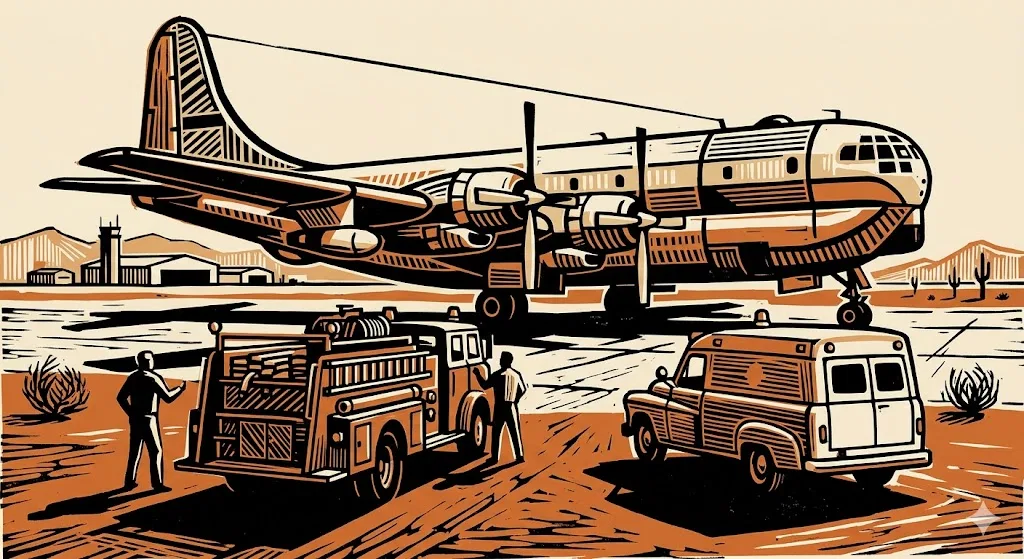
The 1956 KC-97 crash is one later event the Air Force linked to stories of bodies at Roswell.
On this page
- The accident cited by officials
- Why later trauma can merge with legend
- Limits of the explanation
Page outline Jump by section
Introduction
The 1956 KC-97 crash matters to Roswell history because it is one of the later real-world tragedies the U.S. Air Force used to explain some stories about bodies, autopsies, and disturbing scenes at the Roswell base hospital. In the Air Force’s 1997 report, The Roswell Report: Case Closed, investigators argued that memories of several 1950s events — including the fatal KC-97 accident near Walker Air Force Base, formerly Roswell Army Air Field — were later compressed into a supposed 1947 alien-body narrative. The claim is not that a tanker crash explains the original debris recovery in 1947. It is narrower: that some later body stories, especially those linked to mortuary work, hospital activity, burned remains, and autopsies, may have drawn on the aftermath of an actual aviation disaster nine years later.[U.S. Air Force]af.milThe Roswell ReportU.S. Air ForceThe Roswell ReportClaims of "alien bodies" at the Roswell Army Air Field hospital were most likely a 1956 KC-97 aircraft ac…
That distinction is important. Roswell lore often treats “the crash” as one dramatic event: wreckage, bodies, military secrecy, and a cover-up all occurring in July 1947. The KC-97 explanation instead separates the debris story from the body stories. It asks whether later witnesses, interviewers, and retellings may have merged different memories from the same place — Roswell’s military community — into a single legend.
The accident cited by officials
On 26 June 1956, a U.S. Air Force Boeing KC-97G Stratofreighter tanker, registration 52-2700, crashed after take-off from Roswell-Walker Air Force Base in New Mexico. Aviation Safety Network records identify the aircraft as a USAF KC-97G, list 11 fatalities among 11 occupants, and describe the crash sequence as a loss of a blade from the number two propeller, which cut through the fuselage and struck the refuelling tanks before the aircraft rolled into the ground and was destroyed.[Aviation Safety Network]aviation-safety.netOpen source on aviation-safety.net.
The Air Force’s Roswell investigation gave a more detailed version of the same event. It reported that the aircraft was on a refuelling training mission, that the propeller failure occurred four and a half minutes after take-off, and that the likely puncturing of a deck fuel tank caused an intense cabin fire. The aircraft then became engulfed in flames, spun out of control, and was destroyed; all 11 airmen were killed instantly by fire and impact explosion.[Project Gutenberg]gutenberg.orgThe Roswell Report: Case Closed, by James McAndrew—A Project Gutenberg eBook…
Contemporary newspaper reporting also supports the basic outline. An Associated Press account, quoted in a later disaster chronology, described a “gigantic Air Force refueling tanker” crashing in an open field south of Walker Air Force Base, killing all 11 aboard. The same report said the KC-97 caught fire shortly after a 6:50 p.m. take-off, spun into the ground, exploded, and left wreckage scattered over a small area. It also noted that identification of some bodies was slow “considering the circumstances”.[usdeadlyevents.com]usdeadlyevents.com1956 june 26 usaf kc 97 tanker fire crash after takeoff 10m walker afb nm all 111956 june 26 usaf kc 97 tanker fire crash after takeoff 10m walker afb nm all 11
For the Roswell body-story question, the crucial detail is not merely that a fatal crash happened near Roswell. It is what happened afterwards. According to the Air Force report, the remains were recovered from the crash site and taken by members of the 4036th USAF Hospital to the Walker AFB hospital for identification. A specialist from Wright-Patterson AFB arrived the next day to assist, and because the burned and fuel-soaked remains created an overpowering odour and the small hospital lacked proper storage, the identification work was moved to a refrigerated compartment at the base commissary. Three autopsies were then performed by a local Roswell pathologist at a local funeral home.[Project Gutenberg]gutenberg.orgThe Roswell Report: Case Closed, by James McAndrew—A Project Gutenberg eBook…
Those details gave the official explanation its force. A later story about bodies at the base hospital could plausibly contain real memories of a military disaster: burned remains, body bags, a strong smell, identification difficulties, outside specialists, hospital involvement, and autopsies connected to a Roswell funeral home.

Why the KC-97 crash became linked to body stories
The KC-97 accident entered the Roswell debate because of the Air Force’s attempt to explain witness accounts that had grown around alleged alien bodies. The best-known strand involved W. Glenn Dennis, a Roswell mortician whose claims became prominent decades after 1947. Dennis said he received calls from the air base asking about body preservation and small caskets, later went to the base hospital, and heard from a nurse about unusual bodies and an autopsy. Summaries of the Roswell controversy describe Dennis as a major source for the alien-body narrative, especially after interviews by UFO researchers in the late 1980s and early 1990s.[Wikipedia]WikipediaRoswell incidentRoswell incident
The Air Force compared Dennis’s account with documented events at Walker AFB between 1947 and 1960. Its investigators reviewed fatal aircraft accidents in the vicinity and used three filtering questions: were the victims burned in a way that could produce descriptions of “black” or “little” bodies; were the remains taken to the Walker AFB hospital; and were autopsies performed? Out of eight fatal accidents involving Walker AFB during that period, the report said only the June 1956 KC-97 crash met all three criteria.[Project Gutenberg]gutenberg.orgThe Roswell Report: Case Closed, by James McAndrew—A Project Gutenberg eBook…
The overlap was specific. The report argued that the KC-97 accident could explain “very mangled, black, little bodies in body bags”, the odour described in body accounts, the presence of unfamiliar doctors, and a red-haired colonel. It also noted that only three of the 11 crash victims were autopsied — matching the number of bodies in the alleged nurse’s autopsy story — and that the autopsies were performed at Ballard Funeral Home, the funeral home with which Dennis associated himself.[Project Gutenberg]gutenberg.orgThe Roswell Report: Case Closed, by James McAndrew—A Project Gutenberg eBook…
A later article in Air Force Magazine made the same comparison more bluntly. It said Dennis may have “time-shifted and jumbled” unrelated events, and described the 1956 KC-97 casualties as badly burned, mangled, and shortened by loss of lower extremities; it also stated that three autopsies were performed at Ballard Funeral Home, not at the base.[Air & Space Forces Magazine]airandspaceforces.comAir & Space Forces Magazine
This is why the KC-97 episode is best understood as a targeted explanation for one family of Roswell claims, not for every Roswell claim. It addresses a subset of later memories: traumatic, medical, mortuary, and hospital-centred accounts of bodies.
Why later trauma can merge with legend
The official explanation depends on a familiar but controversial mechanism: memory consolidation across time. In this model, people did not necessarily invent every detail. Some may have remembered real things — a military aircraft crash, burned bodies, hurried identification work, unusual hospital activity, funeral-home involvement — but later placed them into the more famous 1947 Roswell frame.
Roswell was unusually vulnerable to that kind of merging. The same military community, the same town, and the same base identity ran through different episodes. Roswell Army Air Field became Walker Air Force Base; the 509th, central to the 1947 press-release story, remained part of the base’s later Cold War history. Walker hosted Strategic Air Command units, and the KC-97 itself was tied to the 509th Aerial Refuelling Squadron. The Air Force report noted that in 1956 Walker AFB housed the 6th and 509th Bombardment Wings, as well as the 509th Aerial Refuelling Squadron equipped with KC-97G aircraft.[Project Gutenberg]gutenberg.orgThe Roswell Report: Case Closed, by James McAndrew—A Project Gutenberg eBook…
The Air Force also argued that the KC-97 accident was only one strand in a broader process. Its 1997 executive summary said body stories at the Roswell base hospital were probably a combination of the 1956 KC-97 accident and a 1959 manned balloon mishap in which two Air Force pilots were injured. Other “alien” sightings, it argued, resembled 1950s anthropomorphic dummy recoveries from high-altitude balloon programmes.[U.S. Air Force]af.milThe Roswell ReportU.S. Air ForceThe Roswell ReportClaims of "alien bodies" at the Roswell Army Air Field hospital were most likely a 1956 KC-97 aircraft ac…
That broader setting matters because it explains why the KC-97 crash alone does not have to carry the entire burden. The Air Force’s theory was a composite explanation for composite stories. Dummies could account for accounts of small, hairless, oddly dressed figures in the desert; the 1959 balloon accident could account for an injured pilot with severe facial swelling; and the KC-97 crash could account for burned, mangled bodies, mortuary involvement, odour, and autopsies.[Project Gutenberg]gutenberg.orgThe Roswell Report: Case Closed, by James McAndrew—A Project Gutenberg eBook…
This makes the explanation more plausible in one respect and more vulnerable in another. It is plausible because legends often do grow by absorbing fragments from real events. It is vulnerable because once an explanation becomes composite, critics can argue that it is too flexible: if one event does not match a detail, another later event is brought in to fill the gap.

What the KC-97 explanation can and cannot explain
The KC-97 evidence is strongest when the claim under discussion includes burned human remains, post-crash odour, body bags, autopsies, and the involvement of a Roswell funeral home. Those are not generic UFO motifs; they closely resemble the documented aftermath of a fatal aviation fire. The match is especially striking because the Air Force did not simply point to “some crash” near Roswell. It surveyed fatal Walker-area aircraft accidents from 1947 to 1960 and identified the 1956 KC-97 accident as the only one meeting its three relevant criteria: burned victims, transport to the Walker hospital, and autopsies.[Project Gutenberg]gutenberg.orgThe Roswell Report: Case Closed, by James McAndrew—A Project Gutenberg eBook…
The explanation is weaker when applied to the entire Roswell mythos. It does not explain the original July 1947 debris recovery, the famous “flying disc” press release, the later Project Mogul argument, or every witness who claimed to have seen bodies at remote crash sites rather than at the hospital. It also cannot prove that a specific witness consciously remembered the 1956 crash and displaced it into 1947. What it provides is circumstantial historical comparison: a later documented event that fits several details in later body narratives better than the 1947 record does.
Critics of the Air Force explanation have often focused on timing. The most obvious objection is that a 1956 accident happened nine years after the alleged 1947 alien recovery. That objection has force if a witness is assumed to be giving a precise, continuous, date-secure memory. But the Air Force’s argument is precisely that many body accounts emerged decades later, after Roswell had become a public UFO legend, and may reflect time compression rather than direct 1947 observation. Britannica’s summary of the 1997 report captures this official view: stories of alien bodies may have come from memories of crash-test dummies, an injured airman, and charred bodies from a 1950s aircraft crash that were later consolidated with the Roswell incident.[Encyclopedia Britannica]britannica.comEncyclopedia Britannica Roswell incident | Overview, Theories, Hoaxes, & FactsEncyclopedia Britannica Roswell incident | Overview, Theories, Hoaxes, & Facts
There is also a source-credibility issue. Dennis became a powerful figure in Roswell storytelling, but later scrutiny raised questions about aspects of his account, including the identity of the alleged nurse. Summaries of the controversy note that he supplied names for the nurse that investigators could not verify, and that some UFO researchers later regarded him as an impeached or unreliable witness.[Wikipedia]WikipediaGlenn DennisGlenn Dennis
That does not automatically make every part of his story false. It does mean the KC-97 comparison has to be evaluated as a historical probability, not as a solved equation. The documented crash shows that Roswell really did experience a horrific military accident with burned bodies, hospital involvement, and funeral-home autopsies. It does not by itself prove how those facts entered a particular person’s memory or a particular author’s retelling.
Limits of the explanation
The KC-97 case is most useful as a warning against treating Roswell as a single sealed moment in July 1947. Roswell lore was built over decades. The body stories became prominent much later than the original debris reports, and they developed in a cultural environment already shaped by UFO books, television reconstructions, alleged witness interviews, and public distrust of official explanations. Contemporary and later journalism noted that the Air Force’s dummy-and-accident explanation did not persuade believers, partly because the dummies and the KC-97 crash belonged to the 1950s rather than to 1947.[Time]time.comaliens or dummiesaliens or dummies
The Air Force’s own framing also sets limits. Its report said the KC-97 crash probably explains “some” reports of bodies at the Walker AFB hospital, not every alleged alien-body claim attached to Roswell. Its conclusion was a best-fit historical explanation across documented records, accident reports, personnel histories, photographs, and interviews, rather than a courtroom-style reconstruction of each later rumour’s path into the legend.[U.S. Air Force]af.milThe Roswell ReportU.S. Air ForceThe Roswell ReportClaims of "alien bodies" at the Roswell Army Air Field hospital were most likely a 1956 KC-97 aircraft ac…
The fairest reading is therefore neither “the KC-97 proves Roswell was nothing” nor “the KC-97 is irrelevant because it happened later”. The crash is relevant because it supplies a documented, local, traumatic source for several vivid body-story details. It is limited because it explains a family of later claims, not the whole Roswell controversy.
For readers trying to understand how Roswell grew, that is the central value of the KC-97 episode. It shows how a real military disaster — with real deaths, real burned remains, real autopsies, and real grief — could be absorbed into a much larger legend about secrecy and alien bodies. The question is not only what happened in 1947, but how later memories from the same landscape were reorganised around 1947 once Roswell became America’s most famous UFO crash story.

Amazon book picks
Further Reading
Books and field guides related to How a 1956 Crash Entered Roswell Lore. Use these as the next step if you want deeper reading beyond the article.
Roswell Incident
Essential context for understanding how body-recovery legends entered Roswell lore.
UFO Crash at Roswell
Directly addresses how Roswell stories evolved and how later narratives became attached to the original event.
The Roswell Report: Case Closed
Contains the Air Force argument linking later events such as the 1956 KC-97 crash to body stories.
The Day After Roswell
Shows how Roswell body and technology claims expanded in later decades.
eBay marketplace picks
Marketplace Samples
Example marketplace items related to this page. Use the search link to explore similar finds on eBay.

Endnotes
1.
Source: gutenberg.org
Title: Project Gutenberg
Link:https://www.gutenberg.org/files/63659/63659-h/63659-h.htm
Source snippet
The Roswell Report: Case Closed, by James McAndrew—A Project Gutenberg eBook...
2.
Source: aviation-safety.net
Link:https://aviation-safety.net/wikibase/334676
3.
Source: usdeadlyevents.com
Title: 1956 june 26 usaf kc 97 tanker fire crash after takeoff 10m walker afb nm all 11
Link:https://www.usdeadlyevents.com/1956-june-26-usaf-kc-97-tanker-fire-crash-after-takeoff-10m-walker-afb-nm-all-11/
4.
Source: Wikipedia
Title: Roswell incident
Link:https://en.wikipedia.org/wiki/Roswell_incident
5.
Source: content.time.com
Title: DID ALIENS REALLY LAND?
Link:https://content.time.com/time/subscriber/article/0%2C33009%2C986565-3%2C00.html
6.
Source: airandspaceforces.com
Title: Air & Space Forces Magazine
Link:https://www.airandspaceforces.com/PDF/MagazineArchive/Documents/2011/June%202011/0611UFO.pdf
7.
Source: Wikipedia
Title: Walker Air Force Base
Link:https://en.wikipedia.org/wiki/Walker_Air_Force_Base
8.
Source: britannica.com
Title: Encyclopedia Britannica Roswell incident | Overview, Theories, Hoaxes, & Facts
Link:https://www.britannica.com/event/Roswell-incident
9.
Source: Wikipedia
Title: Glenn Dennis
Link:https://en.wikipedia.org/wiki/Glenn_Dennis
10.
Source: time.com
Title: aliens or dummies
Link:https://time.com/archive/6930414/aliens-or-dummies/
11.
Source: gutenberg.org
Link:https://www.gutenberg.org/files/63659/old/63659-h/63659-h.htm
12.
Source: history.com
Title: U.S. Air Force reports on Roswell
Link:https://www.history.com/this-day-in-history/june-24/u-s-air-force-reports-on-roswell
13.
Source: Wikipedia
Title: List of accidents and incidents involving military aircraft (1955–1959)
Link:https://en.wikipedia.org/wiki/List_of_accidents_and_incidents_involving_military_aircraft_%281955%E2%80%931959%29
14.
Source: af.mil
Title: The Roswell Report
Link:https://www.af.mil/The-Roswell-Report/
Source snippet
U.S. Air ForceThe Roswell ReportClaims of "alien bodies" at the Roswell Army Air Field hospital were most likely a 1956 KC-97 aircraft ac...
15.
Source: govinfo.gov
Title: The Roswell Report: Case Closed
Link:https://www.govinfo.gov/app/details/GOVPUB-D301-PURL-gpo92195
16.
Source: archive.org
Title: AFD 101027 030
Link:https://archive.org/details/AFD-101027-030
17.
Source: skeptoid.com
Link:https://skeptoid.com/episodes/79
Additional References
18.
Source: youtube.com
Title: The Roswell Incident and UFO Sightings Documentary
Link:https://www.youtube.com/watch?v=HQRyaCBxPeU
Source snippet
4 CNN & HLN 1997 Air Force Roswell Report: Case Closed w/ Lynne Russell...
19.
Source: youtube.com
Link:https://www.youtube.com/watch?v=ctmYX6AcHCc
Source snippet
5 The Roswell Report: Case Closed by James McAndrew | Full Audio Book...
20.
Source: spokesman.com
Link:https://www.spokesman.com/stories/1997/jun/25/dummies-tell-no-tales-air-force-tries-to-close/
21.
Source: medium.com
Link:https://medium.com/%40kevin.bergin1958/roswell-ufo-mystery-a01e1b9c5e63
22.
Source: facebook.com
Link:https://www.facebook.com/groups/446757085724945/posts/2048907428843228/
23.
Source: amazon.com
Link:https://www.amazon.com/-/es/Department-Defense-ebook/dp/B005F9YCL4
24.
Source: reddit.com
Link:https://www.reddit.com/r/UFOs/comments/pukljc/the_roswell_report_case_closed/
25.
Source: reddit.com
Link:https://www.reddit.com/r/UFOs/comments/zfj0nd/these_are_the_dummy_types_the_air_force_claims/
26.
Source: reddit.com
Link:https://www.reddit.com/r/ufo/comments/q8irfj/w_glenn_dennis_interview_roswell_mortician_who/
27.
Source: dafhistory.af.mil
Link:https://www.dafhistory.af.mil/Portals/16/documents/AFD-101201-038.pdf
Topic Tree
Follow this branch
Parent topic
RoswellRelated pages 29
- Burned Remains Why Burned Remains Became the Key Evidence
- Crash Link Did a 1956 Crash Reshape Roswell Body Stories?
- Dennis Claim Did Glenn Dennis Remember the Wrong Disaster?
- Filtering Test How Officials Picked the KC 97 Crash
- Hospital Trail Inside the Walker AFB Body Identification Trail
- +1 more in sidebar