Within Roswell
Did Mogul Flight 4 Land Near Roswell?
Mogul Flight 4 is the specific balloon launch often identified as the likely source of Brazel's debris.
On this page
- Alamogordo launch context
- Material expected from Flight 4
- Why the match is disputed
Page outline Jump by section
Introduction
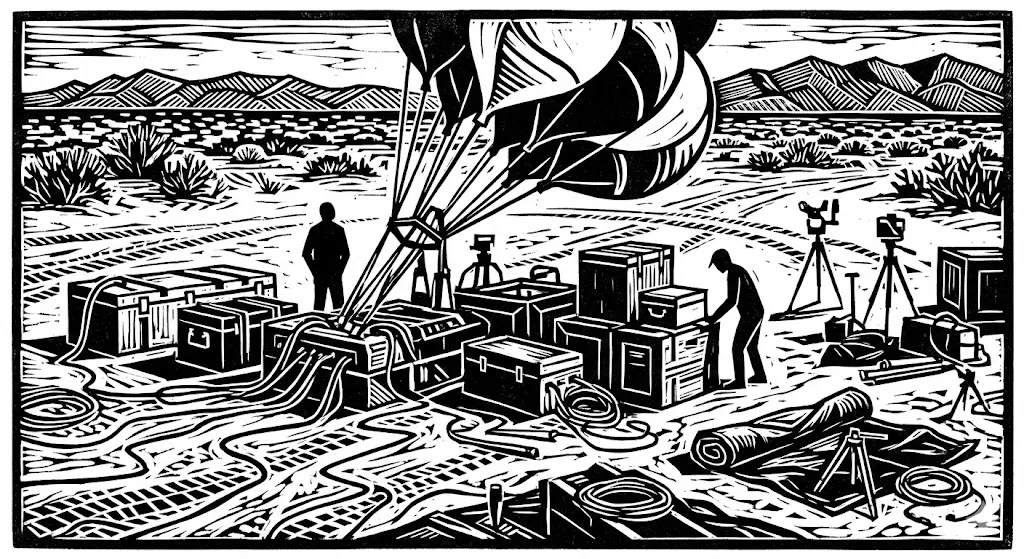
Mogul Flight 4 is the specific Project Mogul balloon train most often proposed as the source of the debris found by rancher W. W. “Mac” Brazel near Roswell in 1947. The case for it is not simply “it was a weather balloon”: the stronger claim is that an unlogged or poorly logged experimental New York University balloon flight, launched from Alamogordo on 4 June 1947, carried materials that closely match the earliest descriptions of the Roswell debris. Those materials included neoprene balloon fragments, foil-backed radar targets, lightweight sticks, tape, paper-like material, and possible instrument components.[Muller Lab]muller.lbl.govMuller Lab Project MogulMuller Lab Project Mogul
The match matters because it explains two otherwise awkward features of the Roswell story at once. First, the debris could look strange to ranchers and even to some military personnel without being extraterrestrial. Secondly, the Army’s quick “weather balloon” explanation could be both misleading and partly true: it hid the classified purpose of the balloon system while pointing to ordinary-looking components. The dispute is over whether Flight 4 can be documented and tracked tightly enough to carry that explanatory weight.[NSA]nsa.govreport af roswellreport af roswell
Why Flight 4 Became the Leading Candidate
Project Mogul was an early Cold War programme designed to detect long-range acoustic signals from Soviet nuclear tests and missile activity. The Air Force’s 1994 Roswell research described it as a classified project using balloon-borne low-frequency acoustic detection, with work divided between groups including New York University, Watson Laboratories, Columbia University and related military offices.[NSA]nsa.govreport af roswellreport af roswell
The Roswell link rests on timing and geography. Air Force researcher James McAndrew’s Project Mogul synopsis says experimental balloon work was being conducted at Alamogordo Army Air Field during the summer of 1947, and that the debris recovered near Roswell was, “with a great degree of certainty”, Mogul Flight 4, launched on 4 June 1947. The argument is that Brazel’s own July 1947 statement placed his first discovery in June, which ruled out later July balloon flights and made an early June lost flight the better candidate.[Muller Lab]muller.lbl.govMuller Lab Project MogulMuller Lab Project Mogul
Flight 4 also matters because the official Mogul records were not as tidy as a reader might expect. The Air Force report says some early “service flights” were not fully logged in the published technical reports, and that gaps existed for Flights 2 to 4 and Flight 9. According to the report, project engineer Charles B. Moore described those missing entries as unlogged service flights made of balloons, radar reflectors and test payloads, rather than fully documented constant-altitude flights.[NSA]nsa.govreport af roswellreport af roswell
That point cuts both ways. For supporters of the Mogul explanation, the irregular records explain why Roswell was not easily solved in 1947 and why later researchers had to reconstruct events from diaries, interviews and technical reports. For critics, the same irregularity is a weakness: the most important candidate flight is not supported by the clean, complete launch-and-recovery documentation one would ideally want for a decisive identification.
Alamogordo Launch Context
The Alamogordo setting is central to the debris match. Mogul was not a normal weather observation programme, even though it used weather-balloon materials. The NYU team experimented with trains of neoprene balloons, ballast systems, radar reflectors, parachutes, sonobuoys and instrument packages. These trains were far larger and more complicated than a routine weather balloon, which helps explain why a wrecked system might be reported as unusual without requiring an exotic craft.[NSA]nsa.govreport af roswellreport af roswell
The Air Force account describes the June field work as developmental. The group was testing configurations and equipment, including balloon trains and payloads associated with acoustic detection. The programme’s classified aim was not necessarily known to all workers, and casual enquiries could be handled as meteorological or balloon research. That compartmentalisation helps explain why the immediate public explanation could sound mundane while still concealing something real.[NSA]nsa.govreport af roswellreport af roswell
This is the key distinction often lost in simplified retellings: the Flight 4 theory does not say Brazel found an ordinary single weather balloon. It says he probably found remnants of an experimental, military-linked balloon train whose unclassified parts looked like weather and radar equipment, while its purpose was tied to a classified nuclear-detection project. The Smithsonian’s Air & Space Magazine similarly identifies Mogul Flight 4, launched from Alamogordo on 4 June 1947, as the likely source of the debris Brazel brought to Sheriff George Wilcox.[Smithsonian Magazine]smithsonianmag.comSmithsonian Magazine Roswell, "The Genesis Story of U.S. UFOsSmithsonian Magazine Roswell, "The Genesis Story of U.S. UFOs
What Flight 4 Should Have Left Behind
The strongest part of the Mogul case is the material fit. Early accounts of the Roswell debris repeatedly describe lightweight, fragile, balloon-associated materials rather than engines, heavy structure, propulsion parts or machinery. The FBI’s 8 July 1947 teletype said the reported “flying disc” resembled a high-altitude weather balloon with a radar reflector, and the FBI Vault page now summarises the message in those terms.[FBI]vault.fbi.govRoswell UFOOnRoswell UFOOn
Brazel’s contemporary newspaper description also fits a balloon-and-reflector system better than a vehicle. Reported debris included rubber strips, tinfoil, tough paper, sticks and tape, with no engine, propeller or substantial metal machinery. Later sceptical analysis emphasises the same point: the earliest debris descriptions are dominated by foil, rubber, sticks, paper-like material and tape, not by the kinds of components expected from an aircraft or spacecraft.[skepticalinquirer.org]skepticalinquirer.orgRoswell UFO 'Strange Metal' MysteryRoswell UFO 'Strange Metal' Mystery
The Air Force’s specific Flight 4 reconstruction adds. It says a Mogul service flight could include neoprene balloons, parchment parachutes, plastic ballast tubes, corner reflectors, a sonobuoy and a black electronics or cut-off box. It also states that the Foster Ranch debris was consistent with as many as 23 small neoprene balloons, several radar targets, ballast tubes, parachute material, a black instrument box and a sonobuoy.[Muller Lab]muller.lbl.govMuller Lab Project MogulMuller Lab Project Mogul
That explains why the debris could have seemed odd. Radar targets were lightweight reflectors made from foil-like material on balsa or similar frames, not solid metal craft parts. If dragged across the ground by partially buoyant balloons, such reflectors could tear apart and scatter over a wider area than their weight alone might suggest. The Air Force report explicitly argues that this kind of break-up could produce a debris field of light material spread across the ground.[Muller Lab]muller.lbl.govMuller Lab Project MogulMuller Lab Project Mogul
The “Hieroglyphics” and the Flowered Tape
One of the most memorable Roswell details is the claim that some wreckage carried strange writing or “hieroglyphic-like” markings. The Mogul explanation gives a concrete, non-exotic account of this feature: some radar targets were reportedly assembled with pinkish-purple tape bearing floral or geometric designs, because a toy or novelty manufacturer had been used in wartime or post-war production.[Muller Lab]muller.lbl.govMuller Lab Project MogulMuller Lab Project Mogul
This is one of the places where the debris match is unusually specific. The Air Force report says witnesses later remembered small pink or purple markings that could look like writing but were consistent with decorative tape used on the seams of radar targets. It also says Irving Newton, the Fort Worth weather officer called to inspect the material, remembered lavender or pink figures on target sticks and identified the debris as a balloon and RAWIN target, meaning radar-wind equipment.[NSA]nsa.govreport af roswellreport af roswell
The “hieroglyphics” issue does not prove Flight 4 by itself. A sceptical reader can reasonably note that memory, retelling and later interpretation complicate all witness evidence in the Roswell case. But it is one of the best examples of how a detail that sounds mysterious in isolation becomes less mysterious when matched against the known construction of radar reflectors used in the Mogul work.
Why the Match Is Disputed
The Flight 4 explanation is strong as a material match but weaker as a perfectly documented reconstruction. Its critics focus on several pressure points: whether Flight 4 was definitely launched, whether its path can be reliably reconstructed, whether the debris field described by later witnesses was too large or dramatic for a balloon train, and whether the material shown in Fort Worth photographs was the same material recovered from Brazel’s ranch.
The launch question is the most important. The Air Force case relies partly on the claim that Flight 4 was one of the unlogged service flights rather than a standard, fully documented numbered flight. The official report treats that gap as explainable because some service flights were expendable, incompletely recorded and kept separate from acknowledged constant-altitude flights. Critics treat the same gap as suspicious or at least inconclusive, arguing that the key flight should not be treated as established beyond doubt if its records are ambiguous.[NSA]nsa.govreport af roswellreport af roswell
The trajectory question is also contested. Sceptical writers have argued that Moore’s wind reconstruction made Flight 4 a plausible candidate, with the balloon train travelling generally towards the Foster Ranch area. The Skeptical Inquirer account says Moore’s analysis placed the likely path consistently with a landing near the ranch, while also acknowledging that Moore had been criticised in UFO literature for changed or disputed statements.[centerforinquiry.s3.amazonaws.com]centerforinquiry.s3.amazonaws.comOpen source on amazonaws.com.
The debris-field question depends heavily on which witness account is being used. The earliest descriptions emphasise light material and modest recovered bundles; later Roswell accounts sometimes describe a much larger and more extraordinary wreckage field. The Air Force explanation fits the early foil-rubber-stick-paper-tape descriptions far better than it fits the most dramatic later claims. That is why many sceptical accounts argue that the Roswell mystery grew as later testimony added details not present in 1947 reporting.[skepticalinquirer.org]skepticalinquirer.orgRoswell UFO 'Strange Metal' MysteryRoswell UFO 'Strange Metal' Mystery
What the Debris Match Can and Cannot Prove
The Flight 4 theory is most persuasive when judged against the earliest, least elaborate evidence. A classified balloon train launched from Alamogordo, carrying radar reflectors and balloon materials, matches the reported rubber, foil, sticks, tape, paper-like material and radar-target description. It also explains why the Army might publicly downgrade the find to a weather balloon while avoiding the classified purpose of Mogul.[lbl.gov]muller.lbl.govMuller Lab Project MogulMuller Lab Project Mogul
It is less decisive as a courtroom-style identification of a single object. The chain from Flight 4’s launch to Brazel’s field is reconstructed rather than documented by a recovered serial number, a signed recovery log from the ranch, or surviving physical debris available for modern testing. The Air Force conclusion is therefore best understood as a probability argument built from timing, location, material descriptions, project records and witness interviews, not as a direct laboratory identification.[NSA]nsa.govreport af roswellreport af roswell
That distinction is important because it keeps the assessment honest. The Mogul explanation does not require dismissing every witness as foolish or dishonest; it requires accepting that a secret, unusual balloon programme created debris that was easy to misread in the summer 1947 flying-disc climate. At the same time, the disputed record of Flight 4 leaves room for critics to argue that the official account is plausible but not conclusively proven in every operational detail.[ResearchGate]researchgate.netOpen source on researchgate.net.
The Best Reading of the Flight 4 Evidence
The most balanced conclusion is that Mogul Flight 4 is the best-supported conventional explanation for Brazel’s debris, especially when the evidence is limited to contemporary descriptions and known balloon equipment. Its materials match the early reports closely; its Alamogordo launch context fits the geography; and the secrecy of Project Mogul explains why the Army’s public story could be evasive without implying an alien spacecraft.[lbl.gov]muller.lbl.govMuller Lab Project MogulMuller Lab Project Mogul
The main unresolved issue is not whether Mogul-like material could explain Roswell. It plainly could. The more precise question is whether the historical record lets Flight 4, specifically, be identified beyond serious dispute as the source. Official and sceptical accounts generally say yes, or very probably. Some UFO researchers say the launch records, trajectory reconstruction and later witness conflicts leave the identification incomplete.[lbl.gov]muller.lbl.govMuller Lab Project MogulMuller Lab Project Mogul
For readers trying to understand Roswell rather than defend a side, Flight 4 is the pivot point. It turns the “weather balloon” story from a flimsy-sounding dismissal into a more specific Cold War explanation: not a common weather balloon, but a classified balloon train whose ordinary fragments were attached to an extraordinary secret purpose.
Amazon book picks
Further Reading
Books and field guides related to Did Mogul Flight 4 Land Near Roswell?. Use these as the next step if you want deeper reading beyond the article.
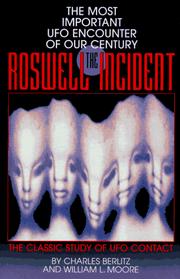
Roswell Incident
Provides the influential alternative interpretation that later Mogul arguments address.
UFO Crash at Roswell
Analyzes how Roswell narratives developed and discusses Mogul evidence.
The Roswell Report: Case Closed
Directly covers the Project Mogul explanation and the Flight 4 hypothesis.
eBay marketplace picks
Marketplace Samples
Example marketplace items related to this page. Use the search link to explore similar finds on eBay.

Endnotes
1.
Source: vault.fbi.gov
Title: Roswell UFOOn
Link:https://vault.fbi.gov/Roswell%20UFO
2.
Source: nsa.gov
Title: report af roswell
Link:https://www.nsa.gov/portals/75/documents/news-features/declassified-documents/ufo/report_af_roswell.pdf
3.
Source: skepticalinquirer.org
Title: Roswell UFO ‘Strange Metal’ Mystery
Link:https://skepticalinquirer.org/newsletter/roswell-ufo-strange-metal-mystery/
4.
Source: ufologie.patrickgross.org
Title: The Roswell [Daily Record]({{ ‘daily-record/’ | relative_url }}),
Link:https://ufologie.patrickgross.org/rw/p/roswelldailyrecord9jul1947.htm
5.
Source: researchgate.net
Link:https://www.researchgate.net/publication/362854511_A_Grounded_Theory_Update_on_the_Roswell_UFO_Incident
6.
Source: centerforinquiry.s3.amazonaws.com
Link:https://centerforinquiry.s3.amazonaws.com/wp-content/uploads/sites/29/1995/07/22165104/p17.pdf
7.
Source: skepticalinquirer.org
Link:https://skepticalinquirer.org/2017/12/the-roswell-incident-at-70-facts-not-myths/
8.
Source: muller.lbl.gov
Title: Muller Lab Project Mogul
Link:https://muller.lbl.gov/teaching/physics10/Roswell/USMogulReport.html
9.
Source: smithsonianmag.com
Title: Smithsonian Magazine Roswell, “The Genesis Story of U.S. UFOs”
Link:https://www.smithsonianmag.com/air-space-magazine/roswell-the-genesis-story-of-us-ufos-140945396/
10.
Source: Wikipedia
Title: Project Mogul
Link:https://en.wikipedia.org/wiki/Project_Mogul
11.
Source: muller.lbl.gov
Title: Roswell Incident
Link:https://muller.lbl.gov/teaching/physics10/Roswell/RoswellIncident.html
12.
Source: smithsonianmag.com
Title: in 1947 high altitude balloon crash landed roswell aliens never left 180963917
Link:https://www.smithsonianmag.com/smithsonian-institution/in-1947-high-altitude-balloon-crash-landed-roswell-aliens-never-left-180963917/
Additional References
13.
Source: youtube.com
Title: Reel America: “The Roswell Reports”
Link:https://www.youtube.com/watch?v=m7rVSri-7es
Source snippet
[Official Reports]({{ 'official-reports/' | relative_url }}) on the Roswell UFO Incident | USAF Documentary | 1997...
14.
Source: youtube.com
Title: The Top Secret Project That Spawned the Roswell UFO Incident
Link:https://www.youtube.com/watch?v=h54XMccPH-Q
Source snippet
Reel America: "The Roswell Reports" - 1997 U.S. Air Force Film...
15.
Source: youtube.com
Title: The Roswell Incident Mystery Finally Solved
Link:https://www.youtube.com/watch?v=Pz0vYcc4KiI
Source snippet
The Top Secret Project That Spawned the Roswell UFO Incident...
16.
Source: facebook.com
Link:https://www.facebook.com/earthshakerph/posts/astrootd-famous-[roswell-ufo-crash
17.
Source: merriam-webster.com
Link:https://www.merriam-webster.com/dictionary/project
18.
Source: daviddarling.info
Link:https://www.daviddarling.info/encyclopedia/M/Mogul.html
19.
Source: sgp.fas.org
Link:https://sgp.fas.org/othergov/roswell.html
20.
Source: scribd.com
Link:https://www.scribd.com/document/118542093/1947-Roswell-Daily-Record-Newspaper-Articles
21.
Source: af.mil
Link:https://www.af.mil/The-Roswell-Report/
22.
Source: reddit.com
Link:https://www.reddit.com/r/UFOs/comments/1tajeuo/the_first_description_telephoned_to_the_fbi_on/
Topic Tree