Within Roswell
Why the Roswell Debris Looked So Strange
The materials described in Roswell can sound exotic when removed from their classified technical context.
On this page
- Reflective targets and foil
- Sticks, tape, and balloon parts
- Why context changes interpretation
Page outline Jump by section
Introduction
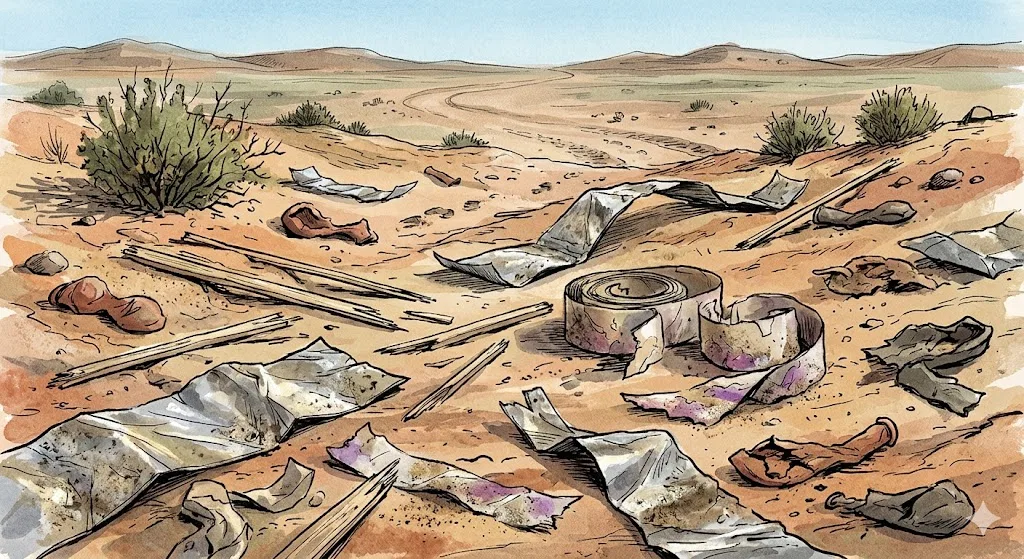
The Roswell debris sounded strange because ordinary balloon materials were being seen without the technical context that made them ordinary. Shredded rubber, foil-backed paper, balsa sticks, tape, eyelets and twine could look like meaningless wreckage in a New Mexico field; in the setting of Project Mogul, they fit the parts of a balloon train and its radar reflectors. The key mechanism is not that mundane objects magically became exotic, but that classified purpose, unfamiliar construction, poor public explanation and later memory turned fragile Cold War equipment into “strange debris”. Contemporary descriptions of the material repeatedly point to lightweight balloon-and-reflector components, while later accounts increasingly framed similar details as anomalous metal, symbols or technology.[whs.mil]esd.whs.milOpen source on whs.mil.
Roswell therefore hinges on a basic interpretive problem: the same pile of scraps could be read as a crashed device, a “weather balloon”, or evidence of something far stranger depending on what the observer knew. In 1947, most people were not being told about a classified balloon system designed to detect Soviet nuclear tests, and even the “weather balloon” explanation understated the scale and purpose of the apparatus.[Muller Lab]muller.lbl.govMuller Lab Project MogulMuller Lab Project Mogul
Reflective Targets and Foil
The most distinctive material in the Roswell story was not a flying-disc hull but a radar target: a lightweight reflector designed to make a balloon train visible to ground radar. Such reflectors were not solid metal machinery. They could resemble angular, box-kite-like structures made of foil-like material over paper, stretched on a balsa frame and held with tape, glue and twine. The 1994 Air Force research report says investigators located blueprints for the Pilot Balloon Target ML-307C/AP assembly and found specifications for foil material, tape, wood, eyelets and string; an examined example consisted of aluminium-coloured foil-like material over stronger paper-like material, attached to balsa sticks.[WHS ESD]esd.whs.milOpen source on whs.mil.
This matters because it explains several “odd” Roswell details at once. A collapsed reflector could leave shiny fragments without leaving engines, propellers, thick aircraft skin or heavy structural members. It could look metallic while still being light enough to crumple, tear and scatter. A July 1947 FBI teletype described the object as hexagonal, suspended from a balloon by cable, and resembling a high-altitude weather balloon with a radar reflector; that is much closer to a balloon-borne target than to a powered craft.[FBI]vault.fbi.govRoswell UFO Part 1 of 1Roswell UFO Part 1 of 1
The foil also helps explain why people remembered something visually striking. In a desert landscape, shredded reflective material can look more dramatic than its weight or strength justify. Smithsonian Magazine describes Brazel’s find as bright wreckage made up of rubber strips, tinfoil, tough paper and sticks, scattered across ranchland north-west of Roswell. Those materials are not impressive as aerospace engineering, but they are visually odd when encountered as a debris field with no label, no owner and no explanation.[Smithsonian Magazine]smithsonianmag.comin 1947 high altitude balloon crash landed roswell aliens never left 180963917in 1947 high altitude balloon crash landed roswell aliens never left 180963917

Sticks, Tape and Balloon Parts
The early descriptions of Roswell debris were notably humble. The Air Force report summarised the July 1947 newspaper account as “sticks, paper, tape and tinfoil”, and contrasted that simple description with later claims about exotic metals, hieroglyphics and fibre-optic-like materials. This contrast is important: the core material list from the contemporary record fits a broken radar target and balloon train better than it fits a crashed aircraft, missile or spacecraft.[WHS ESD]esd.whs.milOpen source on whs.mil.
The “sticks” were not incidental rubbish. They were structurally useful in radar reflectors, where balsa wood could hold foil-paper surfaces at angles that reflected radar energy. The Air Force report says measurements from the sticks visible in Fort Worth photographs were compatible with the wooden materials used in the radar target. Britannica likewise describes the post-Roswell military explanation as a weather balloon carrying a radar target, “somewhat like a box kite”, made from foiled paper fastened to a balsa wood frame.[WHS ESD]esd.whs.milOpen source on whs.mil.
The tape became one of the strangest-looking parts of the story because it apparently carried decorative markings. The Project Mogul synopsis hosted by Lawrence Berkeley National Laboratory says later “hieroglyphic-like” recollections were probably figures printed on pinkish-purple tape used to seal radar-target seams. It explains that a toy company had manufactured some of the targets and, during post-war shortages, used available decorative tape with flowers and geometric designs.[Muller Lab]muller.lbl.govMuller Lab Project MogulMuller Lab Project Mogul
That small procurement detail is a powerful example of how ordinary materials can become uncanny. A strip of novelty tape on a toy-shop-built reflector is banal if the object is identified as a radar target. The same tape, viewed years later through the expectation of alien wreckage, can become “writing” or “symbols”. Science Friday’s account makes the same point in plain terms: Project Mogul’s reflectors were contracted to a toy company, bound with glue and tape, and wartime scarcity helped explain the use of novelty-patterned tape.[Science Friday]sciencefriday.comScience Friday The Real Roswell Cover-Up? Spying On AirScience Friday The Real Roswell Cover-Up? Spying On Air
The balloon material was also easy to misread. Early Mogul flights used clusters of rubber meteorological balloons, while later systems moved towards more durable polyethylene balloons. In Roswell’s case, reports of smoky grey rubber scattered over the ground fit the failure of rubber balloons exposed to sun, wind and impact. The material could be spread over a wide area while still weighing very little, which matches Brazel’s reported impression of lightweight debris rather than machinery.[Wikipedia]WikipediaProject MogulProject Mogul
Why the Debris Field Seemed Bigger Than the Object
A single weather balloon would not normally create the kind of impression Roswell later acquired. Project Mogul equipment, however, was not just a single small balloon. The Air Force’s later Roswell report describes Mogul as using acoustic sensors, radar-reflecting targets and other devices attached to a train of weather balloons more than 600 feet long. Smithsonian’s Air & Space account similarly describes Mogul as a long chain of high-altitude balloons, microphones, sensors and instrumentation intended to detect Soviet atomic tests.[U.S. Department of War]media.defense.govOpen source on defense.gov.(https://media.defense.gov/2010/Oct/27/2001330219/-1/-1/0/AFD-101027-030.pdf)
That scale changes the meaning of the debris. A long balloon train can fail in pieces, drag components along the ground, and distribute light material across a broad patch of ranchland. Science Friday notes that Project Mogul teams used many balloons yoked together in a tall column and added radar reflectors because small high-altitude targets were difficult to track. When such a system came down, it could leave more debris than a person would expect from the phrase “weather balloon”.[Science Friday]sciencefriday.comScience Friday The Real Roswell Cover-Up? Spying On AirScience Friday The Real Roswell Cover-Up? Spying On Air
The phrase “weather balloon” was therefore technically close but publicly misleading. It pointed to the visible family of materials — balloons and tracking targets — while concealing the classified purpose and the larger experimental arrangement. The Air Force synopsis says Ramey’s staff recognised debris resembling a weather balloon, a weather officer identified it as a weather balloon with a metallic radar target, and later research concluded the recovered material was a balloon device used for a Top Secret project rather than for ordinary weather work.[Muller Lab]muller.lbl.govMuller Lab Project MogulMuller Lab Project Mogul
This explains why sceptical and pro-UFO readings can both start from a real tension. The debris was not an ordinary consumer object; it belonged to a secret military research programme. But the unusualness lay in mission, configuration and secrecy, not in alien material science. The material itself remained compatible with foil-paper targets, balsa wood, rubber balloons, tape and simple attachments.[WHS ESD]esd.whs.milOpen source on whs.mil.

Why Context Changes Interpretation
Roswell is a case study in how context assigns meaning to debris. A rancher finding bright fragments, rubber strips and sticks in an isolated field could reasonably think the material was unusual. A military intelligence officer seeing the same fragments during the 1947 flying-saucer wave might overinterpret them. A project engineer familiar with balloon trains and radar targets could see recognisable equipment. Those readings differ not because the scraps changed, but because each observer had a different frame of reference.[Smithsonian Magazine]smithsonianmag.comin 1947 high altitude balloon crash landed roswell aliens never left 180963917in 1947 high altitude balloon crash landed roswell aliens never left 180963917
The classified setting made that problem worse. Project Mogul was intended to detect distant nuclear tests by carrying microphones and related equipment into atmospheric sound channels, a Cold War purpose officials were not willing to disclose publicly. Britannica notes that the military first fostered intrigue by calling the object a “flying disc”, then announced that it was a weather balloon, and only decades later did the Project Mogul explanation become public.[Encyclopedia Britannica]britannica.comOpen source on britannica.com.
A good way to read the debris claims is to separate material description from interpretation. Descriptions such as foil, paper, sticks, tape, rubber, eyelets and string align well with the known construction of radar targets and balloon equipment. Interpretations such as alien metal, unreadable writing or impossible lightweight material depend more heavily on later framing, memory and the assumption that the debris was from a craft. The Air Force report explicitly notes this growth from a simple material description into more exotic later claims.[WHS ESD]esd.whs.milOpen source on whs.mil.
That does not require treating every witness as dishonest. People can remember striking details while mislabelling them, especially after years of retelling and after a story has acquired cultural weight. Decorative tape can become symbols; foil-paper can become strange metal; a radar reflector can become a disc-like device; a classified balloon train can become a “cover-up”. The Roswell debris became strange partly because secrecy prevented the correct technical explanation from being supplied at the moment when impressions were forming.[Muller Lab]muller.lbl.govMuller Lab Project MogulMuller Lab Project Mogul
What the Material Evidence Most Strongly Supports
The strongest debris-specific evidence supports a balloon-and-radar-target explanation rather than an extraterrestrial craft. The contemporary material list is lightweight and improvised-looking. The FBI teletype refers to a balloon and radar reflector. The Air Force report connects the described materials to known radar-target construction, including foil-like paper, balsa sticks, tape, eyelets and string. Later institutional summaries from Britannica and Smithsonian likewise present Project Mogul as the best-supported origin of the debris.[fbi.gov]vault.fbi.govRoswell UFO Part 1 of 1Roswell UFO Part 1 of 1
The most useful takeaway is not simply “it was a balloon”, because that phrase is too small for what people actually encountered. A more accurate summary is that Roswell’s strange debris appears to have been the wreckage of a classified balloon train, including radar reflectors whose reflective surfaces, angular balsa frames and decorative tape looked peculiar when torn apart and found in the desert. Once the Cold War purpose was hidden, the debris was left to be interpreted through confusion, press excitement and later UFO mythology.
Amazon book picks
Further Reading
Books and field guides related to Why the Roswell Debris Looked So Strange. Use these as the next step if you want deeper reading beyond the article.
Roswell Incident
Central source for many later claims about unusual debris and symbols.
Crash at Corona
Focuses directly on Roswell evidence, debris claims, witnesses, and competing interpretations.
eBay marketplace picks
Marketplace Samples
Live-tested eBay searches with available results related to this page.


Endnotes
1.
Source: esd.whs.mil
Link:https://www.esd.whs.mil/Portals/54/Documents/FOID/Reading%20Room/UFOsandUAPs/rosswe1.pdf
2.
Source: britannica.com
Link:https://www.britannica.com/event/Roswell-incident
3.
Source: vault.fbi.gov
Title: Roswell UFO Part 1 of 1
Link:https://vault.fbi.gov/Roswell%20UFO/Roswell%20UFO%20Part%2001%20%28Final%29/at_download/file
4.
Source: Wikipedia
Title: Project Mogul
Link:https://en.wikipedia.org/wiki/Project_Mogul
5.
Source: Wikipedia
Title: Roswell incident
Link:https://en.wikipedia.org/wiki/Roswell_incident
6.
Source: vault.fbi.gov
Title: Roswell UFO
Link:https://vault.fbi.gov/Roswell%20UFO
7.
Source: esd.whs.mil
Title: Roswell Report [Case Closed]({{ ‘case-closed/’ | relative_url }})
Link:https://www.esd.whs.mil/Portals/54/Documents/FOID/Reading%20Room/UFOsandUAPs/RoswellReportCaseClosed.pdf?ver=2017-05-22-113519-430
8.
Source: muller.lbl.gov
Title: Muller Lab Project Mogul
Link:https://muller.lbl.gov/teaching/physics10/Roswell/USMogulReport.html
9.
Source: smithsonianmag.com
Title: in 1947 high altitude balloon crash landed roswell aliens never left 180963917
Link:https://www.smithsonianmag.com/smithsonian-institution/in-1947-high-altitude-balloon-crash-landed-roswell-aliens-never-left-180963917/
10.
Source: sciencefriday.com
Title: Science Friday The Real Roswell Cover-Up? Spying On Air
Link:https://www.sciencefriday.com/articles/the-real-roswell-cover-up-spying-on-air/
11.
Source: muller.lbl.gov
Link:https://muller.lbl.gov/teaching/physics10/Roswell/RoswellIncident.html
12.
Source: [media]({{ ‘media/’ | relative_url }}). defense.gov
Link:https://media.defense.gov/2010/Oct/27/2001330219/-1/-1/0/AFD-101027-030.pdf
13.
Source: smithsonianmag.com
Title: roswell the genesis story of us ufos 140945396
Link:https://www.smithsonianmag.com/air-space-magazine/roswell-the-genesis-story-of-us-ufos-140945396/
14.
Source: media.defense.gov
Title: GENERAL ACCOUNTING OFFICE S SCHIFF
Link:https://media.defense.gov/2021/Jul/13/2002761373/-1/-1/0/GENERAL_ACCOUNTING_OFFICE_S_SCHIFF.PDF
15.
Source: sgp.fas.org
Link:https://sgp.fas.org/othergov/roswell.html
Additional References
16.
Source: youtube.com
Title: The Roswell Incident Mystery Finally Solved
Link:https://www.youtube.com/watch?v=Pz0vYcc4KiI
Source snippet
The Top Secret Project That Spawned the Roswell UFO Incident...
17.
Source: abcnews.com
Link:https://abcnews.com/Technology/fbi-vault-reveals-ufo-roswell-files/story?id=13347754
18.
Source: wsmrmuseum.com
Link:https://wsmrmuseum.com/wp-content/uploads/2020/12/2012-05.pdf
19.
Source: daviddarling.info
Link:https://www.daviddarling.info/encyclopedia/M/Mogul.html
20.
Source: reddit.com
Link:https://www.reddit.com/r/UFOs/comments/wgu7by/roswell_crash_wasnt_a_weather_balloon/
21.
Source: scribd.com
Link:https://www.scribd.com/document/160434858/The-Roswell-Mystery
22.
Source: skepticalinquirer.org
Link:https://skepticalinquirer.org/2017/12/the-roswell-incident-at-70-facts-not-myths/
23.
Source: af.mil
Link:https://www.af.mil/The-Roswell-Report/
24.
Source: jasoncolavito.com
Link:https://www.jasoncolavito.com/the-roswell-teletype.html
25.
Source: medium.com
Link:https://medium.com/%40erikcbrown267/why-the-government-was-playing-with-balloons-around-the-roswell-crash-site-4ec419c7725f
Topic Tree