Within Cavitt
Did Radar Target Parts Fit Cavitt's Story?
Foil-backed paper, light supports, tape, and rubber make Cavitt's description look much closer to radar-target debris than spacecraft wreckage.
On this page
- Foil backed paper and light supports
- Box kite style reflector construction
- Why material matching matters
Page outline Jump by section
Introduction
One of the strongest points in Sheridan Cavitt’s ordinary-material account of the Roswell debris is not simply that he described commonplace objects, but that those objects closely resemble the construction materials used in 1940s radar targets carried beneath military balloon trains. Cavitt recalled reflective foil-like material, thin bamboo-like sticks, and a small instrument component rather than heavy metal, engines, or advanced machinery. Those details match the known design of radar reflectors used on balloon projects far more closely than they resemble the wreckage of a sophisticated aircraft or spacecraft.[National Security Agency]nsa.govbalsa wood sticks, affixed with tape, glue, and twine.Read moreNational Security Agencyreport of air force research regarding theMarch 24, 2018 — 21 Jul 1994 — These targets were made up of aluminum "…
 The significance of this match lies in the level of detail. Radar targets were not just balloons. They were lightweight assemblies built from foil-backed surfaces, wooden supports, tape, twine, and small attached instruments. When such structures broke apart and scattered across open ranch land, they could leave exactly the kind of debris field Cavitt described.[National Security Agency]nsa.govbalsa wood sticks, affixed with tape, glue, and twine.Read moreNational Security Agencyreport of air force research regarding theMarch 24, 2018 — 21 Jul 1994 — These targets were made up of aluminum "…
Foil-Backed Paper and Light Supports
Cavitt’s affidavit and later interviews described debris consisting of reflective material resembling aluminium foil together with thin bamboo-like sticks. Those are not random features. The U.S. Air Force’s Roswell investigation identified early radar targets used in balloon programmes as being constructed from aluminium foil or foil-backed paper attached to lightweight balsa-wood members. The same reports note the use of reinforcing tape, twine, glue, and other light materials designed to keep the reflector airborne while adding minimal weight.[nsa.gov]nsa.govbalsa wood sticks, affixed with tape, glue, and twine.Read moreNational Security Agencyreport of air force research regarding theMarch 24, 2018 — 21 Jul 1994 — These targets were made up of aluminum "…
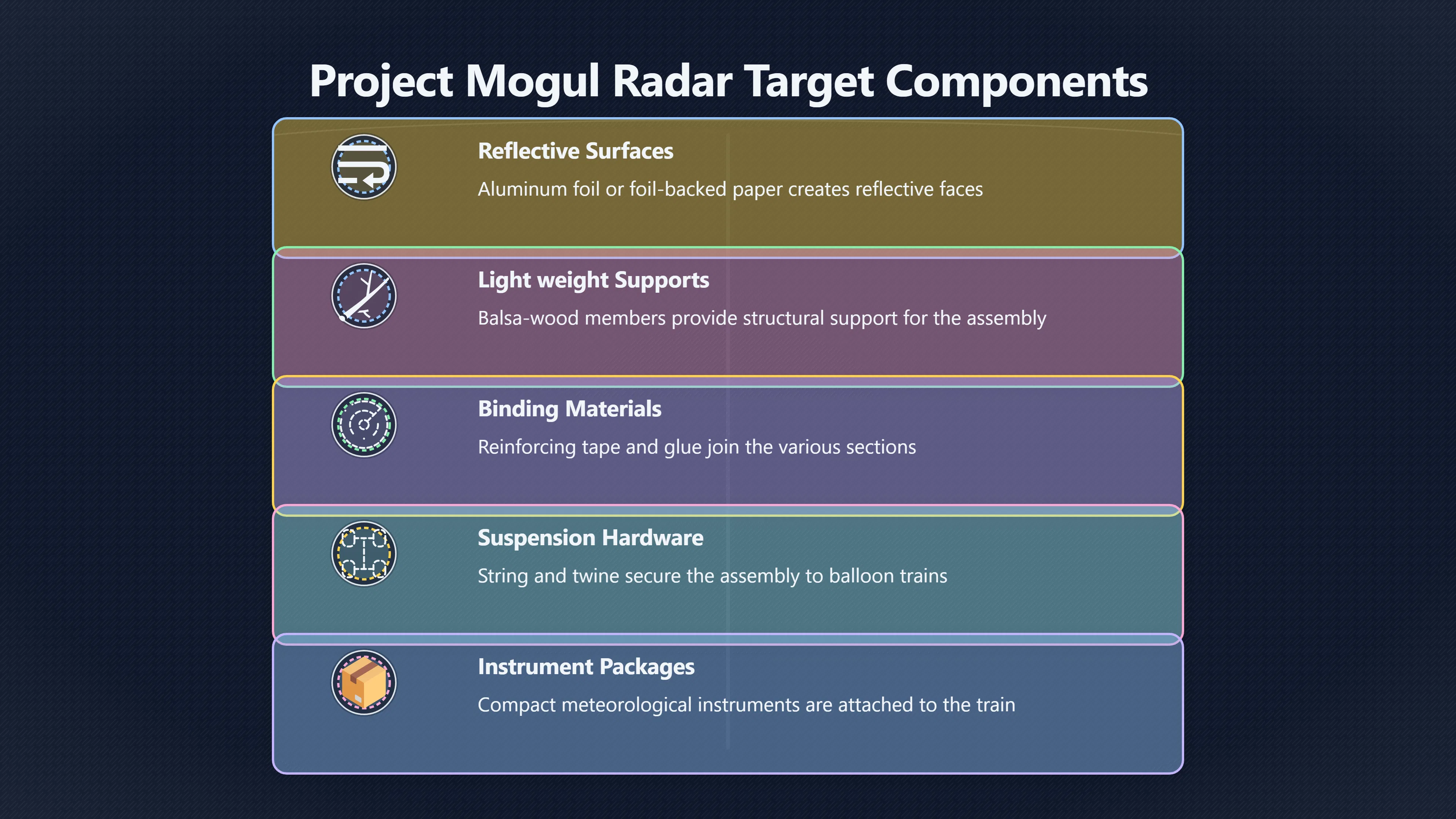
This matters because radar reflectors were engineered to be as light as possible. A large metallic structure would have been impractical beneath high-altitude balloons. Instead, designers used:
- Foil or foil-backed paper to create radar-reflective surfaces.
- Lightweight balsa-wood supports. [media](/media/). defense.gov
- Tape and glue to join sections.
- String, twine, and small fittings to suspend the assembly.
- Compact meteorological instruments attached to the balloon train.[National Security Agency]nsa.govbalsa wood sticks, affixed with tape, glue, and twine.Read moreNational Security Agencyreport of air force research regarding theMarch 24, 2018 — 21 Jul 1994 — These targets were made up of aluminum "…
A witness encountering the wreckage after weather exposure might reasonably describe the wooden members as bamboo-like sticks. Cavitt’s wording therefore aligns with the appearance of the materials rather than with their exact manufacturing specifications.[Cipher Mysteries]ciphermysteries.comthe roswell capsule was it tex settles flying coffinCipher MysteriesThe Roswell capsule: was it Tex Settle's Flying Coffin?15 Jan 2026 — He stated unequivocally, however, that the material…
Box-Kite-Style Reflector Construction
The physical design of the radar targets is especially relevant. Air Force documentation describes the reflectors as multi-faced structures assembled from foil-covered surfaces supported by balsa beams and connected with tape, twine, eyelets, and glue. The reports compare their construction to a box kite.[National Security Agency]nsa.govbalsa wood sticks, affixed with tape, glue, and twine.Read moreNational Security Agencyreport of air force research regarding theMarch 24, 2018 — 21 Jul 1994 — These targets were made up of aluminum "…
When intact, these corner reflectors formed angular geometric shapes that reflected radar signals back toward a receiver. When damaged or collapsed, however, the structure lost its recognisable form. What remained on the ground would be scattered fragments of:
- Reflective foil surfaces.[ciphermysteries.com]ciphermysteries.comthe roswell capsule was it tex settles flying coffinCipher MysteriesThe Roswell capsule: was it Tex Settle's Flying Coffin?15 Jan 2026 — He stated unequivocally, however, that the material… * Thin wooden sticks.
- Adhesive tape.
- String and connecting hardware.
- Pieces of balloon material.[National Security Agency]nsa.govbalsa wood sticks, affixed with tape, glue, and twine.Read moreNational Security Agencyreport of air force research regarding theMarch 24, 2018 — 21 Jul 1994 — These targets were made up of aluminum "…
That breakdown pattern helps explain why multiple contemporary descriptions of the Roswell debris mention combinations of foil, paper, rubber, tape, and sticks rather than large structural components. Contemporary accounts from 1947 similarly referred to tinfoil, paper, tape, rubber strips, and sticks gathered from the ranch.[Wikipedia]WikipediaRoswell incidentRoswell incident
The geometry of a collapsed radar reflector could also appear unusual to someone unfamiliar with the device. Historians of Project Mogul have noted that the reflectors consisted of odd-looking angular assemblies made from lightweight materials, making them visually distinctive even though they were built from ordinary components.[Wikipedia]WikipediaProject MogulProject Mogul
Why Material Matching Matters
The importance of the material match is not that it conclusively proves which specific balloon flight produced the debris. Rather, it provides a mechanism that explains Cavitt’s observations using known equipment from the period.
Several elements line up simultaneously:
Cavitt’s descriptionTypical radar-target materialReflective foil-like sheetsAluminium foil or foil-backed paperThin bamboo-like sticksLightweight balsa-wood supportsSmall instrument boxRadiosonde or related instrument packageScattered lightweight debrisCollapsed balloon-borne reflector assembly
The more individual details that correspond, the less the account resembles the wreckage of a large advanced craft and the more it resembles a damaged radar-target array. Air Force investigators highlighted this correspondence when evaluating Roswell witness testimony decades later.[National Security Agency]nsa.govbalsa wood sticks, affixed with tape, glue, and twine.Read moreNational Security Agencyreport of air force research regarding theMarch 24, 2018 — 21 Jul 1994 — These targets were made up of aluminum "…
Even some of the more unusual details reported by later witnesses have been linked to radar-target construction. Researchers studying the reflector materials noted that decorative printed tape used during post-war manufacturing shortages could account for reports of strange symbols or markings seen on some fragments. Whether every witness remembered those details accurately remains disputed, but the existence of such materials demonstrates that seemingly odd debris did not necessarily require an exotic origin.[Muller Lab]muller.lbl.govMuller LabProject MogulThese figures were printed on tape that sealed the seams of the of the radar target. The radar targets, sometimes…
The Narrow Significance of Cavitt’s Testimony
Within the Roswell debate, Cavitt’s account is important because it focuses on physical materials rather than speculation. He did not describe propulsion systems, thick structural metal, alien bodies, or advanced technology. Instead, he remembered lightweight reflective material, slender support sticks, and a small instrument package.[Cipher Mysteries]ciphermysteries.comthe roswell capsule was it tex settles flying coffinCipher MysteriesThe Roswell capsule: was it Tex Settle's Flying Coffin?15 Jan 2026 — He stated unequivocally, however, that the material…
Those recollections closely mirror the documented construction of balloon-borne radar reflectors used during the same period. As a result, Cavitt’s testimony is frequently cited as one of the clearest examples of how the debris description can be interpreted through known radar-target technology rather than through the hypothesis of a crashed spacecraft.
Amazon book picks
Further Reading
Books and field guides related to Did Radar Target Parts Fit Cavitt's Story?. Use these as the next step if you want deeper reading beyond the article.
Witness to Roswell
Focuses heavily on witness testimony and debris accounts, making it useful for evaluating claims about materials found at the crash site.
Truth About the Ufo Crash at Roswell
Directly addresses competing explanations for the debris, including balloon and radar-target interpretations.
UFO Crash at Roswell
Explores the historical evolution of Roswell claims and includes discussion of balloon and radar-target explanations central to Cavitt-re...
Roswell Incident
Provides core background on the Roswell debris controversy that frames debates over whether ordinary radar-target materials fit witness d...
eBay marketplace picks
Marketplace Samples
Example marketplace items related to this page. Use the search link to explore similar finds on eBay.
Endnotes
1.
Source: [media]({{ ‘media/’ | relative_url }}). defense.gov
Title: AFD 101027 030
Link:https://media.defense.gov/2010/Oct/27/2001330219/-1/-1/0/AFD-101027-030.pdf
Source snippet
Department of WarU.S. Air Force: "The Roswell Report: Case Closed"taped to a balsa wood frame, several ML-307B/AP radar targets were used...
2.
Source: esd.whs.mil
Link:https://www.esd.whs.mil/Portals/54/Documents/FOID/Reading%20Room/UFOsandUAPs/rosswe1.pdf
Source snippet
Report of Air Force Research Regarding the "Roswell...27 Jul 1994 — These targets were made up of aluminum "foil" or foil-backed pape...
3.
Source: Wikipedia
Title: Roswell incident
Link:https://en.wikipedia.org/wiki/Roswell_incident
4.
Source: Wikipedia
Title: Project [Mogul]({{ ‘mogul/’ | relative_url }})
Link:https://en.wikipedia.org/wiki/Project_Mogul
5.
Source: youtube.com
Title: The Roswell Incident Mystery Finally Solved
Link:https://www.youtube.com/watch?v=Pz0vYcc4KiI
Source snippet
Project Mogul...
6.
Source: youtube.com
Title: Project Mogul
Link:https://www.youtube.com/watch?v=mBcYtSsPIuU
Source snippet
Ask an Expert: The Roswell Incident...
7.
Source: nsa.gov
Title: balsa wood sticks, affixed with tape, glue, and twine.Read more
Link:https://www.nsa.gov/portals/75/documents/news-features/declassified-documents/ufo/report_af_roswell.pdf
Source snippet
National Security Agencyreport of air force research regarding theMarch 24, 2018 — 21 Jul 1994 — These targets were made up of aluminum "...
Published: March 24, 2018
8.
Source: ciphermysteries.com
Title: the roswell capsule was it tex settles flying coffin
Link:https://ciphermysteries.com/2026/01/15/the-roswell-capsule-was-it-tex-settles-flying-coffin
Source snippet
Cipher MysteriesThe Roswell capsule: was it Tex Settle's Flying Coffin?15 Jan 2026 — He stated unequivocally, however, that the material...
9.
Source: muller.lbl.gov
Link:https://muller.lbl.gov/teaching/physics10/Roswell/USMogulReport.html
Source snippet
Muller LabProject MogulThese figures were printed on tape that sealed the seams of the of the radar target. The radar targets, sometimes...
Additional References
10.
Source: youtube.com
Title: Roswell’s Bizarre UFO Crash
Link:https://www.youtube.com/watch?v=o1RS7D_szJo
Source snippet
The Roswell Incident Mystery Finally Solved - YouTube The Roswell Incident Mystery Finally Solved - YouTube...
11.
Source: cdn.centerforinquiry.org
Link:https://cdn.centerforinquiry.org/wp-content/uploads/sites/29/1995/01/22165111/p43.pdf
Source snippet
Center for InquiryAir Force Report on the Roswell Incident22 Apr 2021 — These targets were made up of aluminum "foil" or foil- backed pap...
12.
Source: youtube.com
Title: Ask an Expert: The Roswell Incident
Link:https://www.youtube.com/watch?v=foJWblpzEjA
Source snippet
Was the Crash in Roswell a Weather Balloon?...
13.
Source: youtube.com
Title: Was the Crash in Roswell a Weather Balloon?
Link:https://www.youtube.com/watch?v=fAArhGRN5xk
Source snippet
Roswell's Bizarre UFO Crash...
14.
Source: ufosandusos.com
Title: Tab 2 REV
Link:https://www.ufosandusos.com/Tab%202_REV.html
Source snippet
[USAF 1995 report].Read more...
Topic Tree