Within Roswell
How Media Turned Roswell Into Legend
Later books and television helped transform a brief 1947 news item into a durable alien-crash legend.
On this page
- The quiet years after 1947
- Books and television revival
- How repetition changed the story
Page outline Jump by section
Introduction
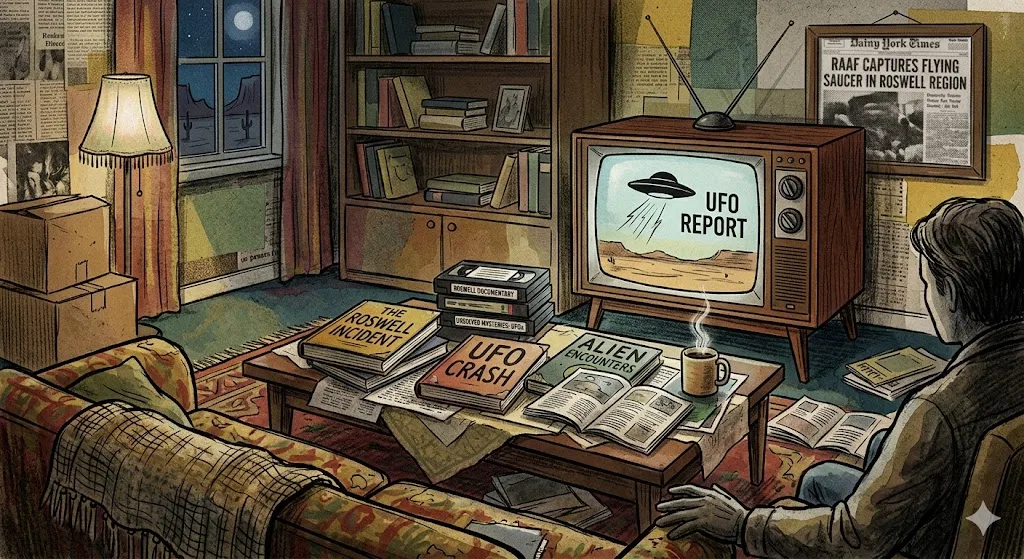
Roswell became a modern alien-crash legend less because of what was reported in July 1947 than because later books and television kept rebuilding the story. For more than 30 years after the original “flying saucer” headline, Roswell was not the centrepiece of UFO culture. Its revival began when retired intelligence officer Jesse Marcel was reinterviewed in the late 1970s, then accelerated through the 1980 book The Roswell Incident, later witness-hunting books, television reconstructions, the 1995 alien-autopsy broadcast, and science-fiction shows that absorbed Roswell into everyday pop culture. The result was a feedback loop: books supplied witnesses and plotlines; television supplied faces, images, mood and repetition; later books then treated the enlarged public story as something needing further explanation.
This page focuses on that mythmaking process. It does not retell the whole Roswell crash case. The key point is narrower: books and television did not merely report Roswell; they changed what “Roswell” meant, shifting it from a brief Cold War debris story into a durable narrative of crashed craft, alien bodies, hidden archives and government denial. Official and institutional sources still point to military balloon and later dummy-recovery explanations rather than extraterrestrial bodies, but the media history explains why those explanations have never ended the legend.[af.mil]af.milU.S. Air ForceThe Roswell Report…
The quiet years after 1947
The original Roswell story had the ingredients of a future legend: a local military press release, a newspaper headline claiming a “flying saucer”, a swift official reversal, and a Cold War setting in which secrecy was normal. Yet it did not immediately become the elaborate alien-crash story familiar today. The National Archives notes that it has been unable to locate documentation on the 1947 Roswell incident within Project Blue Book records, while also recording that a 1994 Air Force study was initiated after decades of pro-UFO claims that an extraterrestrial craft and occupants had been recovered and hidden.[National Archives]archives.govNational Archives Project BLUE BOOKNational Archives Project BLUE BOOK
That gap matters. Roswell’s later fame can make it seem as though Americans spent the late 1940s and 1950s obsessing over alien bodies in New Mexico. In reality, the most developed Roswell mythology came much later. The Smithsonian’s National Air and Space Museum frames the 1947 incident as one that “entangled the United States Army in UFO conspiracy theories that persist to this day”, but also stresses the early Cold War context in which unusual military activity, public anxiety and secrecy could be misread or reinterpreted.[National Air and Space Museum]airandspace.si.edureports ufos 1947 roswell incidentreports ufos 1947 roswell incident
The long quiet period gave later authors room to work. By the time Roswell re-emerged, many direct memories were decades old, some central figures had died, and a wider UFO culture had already developed expectations about crashed saucers, retrieved bodies and hidden technology. That meant later Roswell books were not simply adding new testimony to a stable 1947 record. They were reconstructing an old event inside a much richer UFO storytelling environment.
Books turned a local incident into a plot
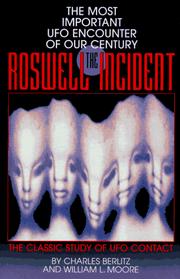
The major turning point was The Roswell Incident, published in 1980 by Charles Berlitz and William L. Moore. Bibliographic records identify it as a 1980 Grosset & Dunlap book by Berlitz and Moore, and later summaries describe it as one of the works that brought the case back into public attention after Stanton Friedman’s late-1970s interview with Jesse Marcel.[Internet Archive]archive.orgOpen source on archive.org.
The book’s importance was not just that it argued Roswell involved extraterrestrials. It gave the story a recognisable architecture. Marcel’s recollections became the anchor; the official weather-balloon explanation became evidence of a cover-up; rumours of bodies were connected to the debris story; and the 1947 ambiguity was turned into a narrative of recovered alien technology. Google Books’ listing for The Roswell Incident describes the book’s pitch in exactly those terms: a “mysterious UFO crash”, a “government cover-up”, and hidden facts about the most important UFO encounter of the century.[Google Books]books.google.comBooks The Roswell IncidentBooks The Roswell Incident
That structure was powerful because it offered readers a complete mystery, not just an unresolved historical question. It supplied:
- A central witness: Jesse Marcel, a military intelligence officer who had handled the debris.
- A reversal to explain: the rapid shift from “flying saucer” to balloon.[airandspace.si.edu]airandspace.si.edu1947 year flying saucer1947 year flying saucer
- A moral frame: authorities allegedly knew more than they admitted.
- A widening cast: ranchers, radio operators, military personnel, undertakers and anonymous insiders.
- A physical promise: wreckage and bodies that, if found, would settle the case.
Later researchers and writers built on, revised or disputed this structure. Kevin Randle and Donald Schmitt’s UFO Crash at Roswell appeared in 1991, followed by The Truth About the UFO Crash at Roswell in 1994. Internet Archive records identify the 1994 book as an Avon publication on the Roswell incident and unidentified flying objects.[Internet Archive]archive.orgisbn 9780380778034isbn 9780380778034 These books pushed Roswell further into witness-driven reconstruction: more interviews, more alleged crash sites, more body-recovery claims and more detailed arguments about military secrecy.
The book tradition also created a problem that became part of the legend itself. As the number of accounts grew, they did not always fit together. Different authors proposed different sites, timelines and witnesses. For believers, this could be explained as the expected confusion around a suppressed event. For sceptics, it showed how a sparse 1947 record had been enlarged by decades of memory, rumour and selective quotation. Smithsonian Books’ page for UFO Crash at Roswell: The Genesis of a Modern Myth presents the case in precisely those terms: not only what wreckage was found, but why many people came to believe in later tales of alien intrusion and what hopes and fears those tales expressed.[Smithsonian Books Store]smithsonianbooks.comOpen source on smithsonianbooks.com.

Television made Roswell visible
Books supplied the detailed claims, but television gave Roswell its mass emotional form. A reader could imagine a debris field or a secret hangar; television could show it, dramatise it and repeat it to millions.
One of the key bridges was the paranormal documentary format. Programmes such as In Search of… and Unsolved Mysteries treated Roswell as an investigation in which witnesses, reconstructions and unresolved questions could be arranged for suspense. The television grammar mattered: low lighting, desert landscapes, official-looking documents, solemn narration and re-enacted military secrecy all helped convert uncertain memories into a coherent viewing experience.
The 1989 Unsolved Mysteries Roswell segment was especially important because it moved the case beyond specialist UFO readers. IMDb records the relevant episode as airing on 20 September 1989 and listing Stanton Friedman and Jesse Marcel Jr. among its participants.[IMDb]imdb.comUnsolved Mysteries" Episode #2.1 (TVUnsolved Mysteries" Episode #2.1 (TV The format did not require viewers to accept every claim. It only required them to feel that something serious had been left unresolved. That is a powerful mythmaking position: the programme could dramatise a cover-up while presenting itself as merely asking questions.
Television films then gave the Roswell legend a more polished dramatic shape. The 1994 Showtime film Roswell, also known as Roswell: The U.F.O. Cover-Up, was based on Randle and Schmitt’s UFO Crash at Roswell, according to contemporary listings and film databases.[IMDb]imdb.comOpen source on imdb.com. That adaptation mattered because it moved the case from interview-based documentary into character-led drama. Jesse Marcel could become not only a witness but a protagonist: a loyal military man trying to reconcile duty, secrecy and conscience.
Television’s effect was cumulative. A claim first encountered in a book could reappear as a witness interview, then as a dramatised scene, then as a clip in a later documentary. Each repetition made the story feel older and more established, even when the underlying evidence remained contested.
The alien-autopsy broadcast changed the imagery
The 1995 Alien Autopsy: Fact or Fiction? special gave Roswell mythmaking one of its most memorable images: grainy black-and-white footage allegedly showing an autopsy on an extraterrestrial body from the 1947 crash. The footage was promoted by London-based producers Ray Santilli and Gary Shoefield and was presented as connected to Roswell at a moment when paranormal television and The X-Files had primed audiences for official-secrecy narratives. TIME later reported that the Fox documentary special aired three times and drew 11.7 million viewers to one screening.[Time]time.comOpen source on time.com.
The autopsy film was not a Roswell source in any rigorous historical sense. Its provenance could not be established, the supposed cameraman was not credibly identified, and by the following year a broad sceptical consensus had developed that it was probably a hoax. TIME’s retrospective account says Santilli admitted in a 2006 Sky programme that the film sold to Fox was fake, while still claiming it was a reconstruction of damaged original footage; it also reports that sculptor John Humphreys made the alien body using materials including lamb bones.[Time]time.comOpen source on time.com. The Guardian similarly described Santilli and Shoefield as revealing that the film was fake while continuing to claim that a genuine original had once existed.[The Guardian]theguardian.comThe Guardian Alien Autopsy | Culture | The GuardianThe Guardian Alien Autopsy | Culture | The Guardian
Its significance lies in what it did to the public imagination. Earlier Roswell stories asked people to picture unusual debris, secret hangars and small bodies. The autopsy special appeared to show the body itself. Even after debunking, the image remained useful to the mythology because it provided a visual shorthand: Roswell was no longer only a disputed recovery story; it was the place one imagined whenever television showed a grey alien on an operating table.
The episode also demonstrated a recurring feature of Roswell media. Exposure did not necessarily erase the myth. It added another layer. For sceptics, the autopsy became a cautionary tale about television sensationalism. For some believers, the confession could be folded into a larger pattern of disinformation: perhaps this film was fake, but the fake might still point towards something real. In that sense, the hoax did not end Roswell’s media life; it helped teach later programmes how to package doubt itself.

Fiction folded Roswell into popular culture
Once Roswell became a recognisable media symbol, fictional television could use it without explaining much. A reference to Roswell could instantly evoke crashed saucers, alien bodies, secret bases and government denial. That shorthand is one reason the legend spread beyond UFO subcultures into mainstream entertainment.
The X-Files was central to this shift. The series did not depend only on Roswell, but its broader world of alien cover-ups, informants, black projects and withheld truth made Roswell feel like part of a larger American mythology. TIME’s account of the alien-autopsy hoax notes that a 1996 episode of The X-Files, “Jose Chung’s From Outer Space”, mocked the autopsy-video genre soon after the Fox broadcast.[Time]time.comOpen source on time.com. Satire is a sign of cultural arrival: by then, viewers were expected to recognise the conventions well enough to understand the joke.
Roswell also became a setting and brand in youth and science-fiction drama. The Roswell High novels, followed by the television series Roswell and later Roswell, New Mexico, shifted the name away from documentary-style claims and into romance, identity and teen science fiction. That kind of fictionalisation did not argue the historical case, but it normalised Roswell as a cultural place where aliens, secrecy and human emotion belonged together.
This fictional afterlife softened the line between case history and pop symbol. For many viewers, Roswell was encountered first not through Air Force reports, newspaper archives or UFO books, but through drama, parody and genre television. The historical incident became a reusable setting: a desert origin story for aliens living among humans.
Repetition changed the story itself
The Roswell legend grew through repetition, but not simple repetition. Each retelling tended to add, select or reframe. A book might foreground witness testimony; a television documentary might foreground mystery; a drama might foreground conscience and cover-up; a hoax special might foreground the body. Over time, these layers created a story that felt more detailed than the original evidence could support.
The mechanism worked in several ways.
First, later claims were back-projected onto 1947. Alien-body stories became so familiar that many people assumed they had been part of Roswell from the beginning. Yet the official Air Force position in The Roswell Report was that later body claims were better explained by later military activities, including anthropomorphic dummy recovery operations and actual injury or death incidents, rather than by alien occupants recovered in 1947.[U.S. Air Force]af.milThe Roswell Report…
Second, the cover-up frame made contradictions survivable. In ordinary historical inquiry, conflicting witness accounts weaken a story. In a conspiracy frame, conflict can be reinterpreted as evidence of intimidation, compartmentalisation or deliberate confusion. This made Roswell unusually resilient: a missing document, a changed name, a disputed location or an altered timeline did not necessarily end the narrative for believers.
Third, visual media rewarded the most dramatic version. Weather-balloon debris, radar reflectors and classified acoustic surveillance are historically important but visually modest. Alien bodies, hidden hangars and autopsy footage are television-ready. The more visual version was not automatically the better-evidenced one, but it was easier to remember and repeat.
Fourth, official secrecy supplied a real seed for suspicion. The Air Force later acknowledged that the simple weather-balloon explanation had obscured a classified balloon programme, Project Mogul, designed for long-range detection of Soviet nuclear tests. Britannica summarises the irony clearly: Berlitz and Moore were wrong about an alien craft, but the original weather-balloon story was also incomplete because the material was linked to a secret military balloon project.[Encyclopedia Britannica]britannica.comEncyclopedia Britannica Roswell incident | Overview, Theories, Hoaxes, & FactsEncyclopedia Britannica Roswell incident | Overview, Theories, Hoaxes, & Facts That partial secrecy gave later media a genuine ambiguity to dramatise, even when official investigations did not support the extraterrestrial conclusion.
Why the media-made Roswell endured
Roswell endured because it became more than a claim about debris. It became a story form: ordinary people glimpse something extraordinary; the military arrives; the explanation changes; witnesses wait decades to speak; records are missing or contested; television asks whether the truth is hidden. That structure is simple, portable and emotionally satisfying.
Books gave the legend depth. They named witnesses, compared accounts, argued over crash sites and invited readers to become investigators. Television gave it immediacy. It put faces to claims, staged the desert, and turned uncertainty into atmosphere. Fiction then gave Roswell a second life, one where historical evidence mattered less than symbolic usefulness.
The result is a durable split. In institutional and sceptical accounts, Roswell is best understood through Cold War secrecy, Project Mogul, later memory contamination, dummy-recovery stories and media exaggeration. In believer accounts, the same elements are read as fragments of a larger suppressed truth. The mythmaking power of books and television lies in how they made that split feel permanent: every official clarification could become either an explanation or another scene in the cover-up story.
That is why Roswell remains recognisable long after many other UFO cases have faded. It was not simply kept alive by belief. It was kept alive by formats — paperback investigation, witness-driven documentary, dramatic reconstruction, television hoax, science-fiction serial and pop-cultural shorthand — that repeatedly taught new audiences how to imagine the crash.
Amazon book picks
Further Reading
Books and field guides related to How Media Turned Roswell Into Legend. Use these as the next step if you want deeper reading beyond the article.
Roswell Incident
The book that helped transform Roswell from a historical incident into a mass-media legend.
Area 51
Explores the wider culture of government secrecy that fuels Roswell narratives.
Witness to Roswell
Shows how witness narratives expanded and reinforced the Roswell story.
The Demon-Haunted World
Rating: 4.5/5 from 43 Google Books ratings
Provides tools for understanding belief, evidence, and popular myths.
eBay marketplace picks
Marketplace Samples
Example marketplace items related to this page. Use the search link to explore similar finds on eBay.
Endnotes
1.
Source: af.mil
Title: U.S. Air Force
Link:https://www.af.mil/The-Roswell-Report/
Source snippet
The Roswell Report...
2.
Source: archives.gov
Title: National Archives Project BLUE BOOK
Link:https://www.archives.gov/research/military/air-force/ufos
3.
Source: archive.org
Link:https://archive.org/details/roswellincident00berl
4.
Source: time.com
Title: roswell history
Link:https://time.com/3916193/roswell-history/
5.
Source: books.google.com
Title: Books The Roswell Incident
Link:https://books.google.com/books/about/The_Roswell_Incident.html?id=AwPL_isJdjoC
6.
Source: archive.org
Title: isbn 9780380778034
Link:https://archive.org/details/isbn_9780380778034
7.
Source: imdb.com
Title: “Unsolved Mysteries” Episode #2.1 (TV
Link:https://www.imdb.com/title/tt0837057/
8.
Source: imdb.com
Link:https://www.imdb.com/title/tt0111021/
9.
Source: time.com
Link:https://time.com/4376871/alien-autopsy-hoax-history/
10.
Source: britannica.com
Title: Encyclopedia Britannica Roswell incident | Overview, Theories, Hoaxes, & Facts
Link:https://www.britannica.com/event/Roswell-incident
11.
Source: history.com
Title: s most infamous ufo sightings
Link:https://www.history.com/articles/historys-most-infamous-ufo-sightings
12.
Source: history.com
Link:https://www.history.com/videos?watch=sitemap.xml
13.
Source: books.google.com
Title: The [Roswell UFO Crash]({{ ‘roswell-ufo-crash/’ | relative_url }})
Link:https://books.google.com/books/about/The_Roswell_UFO_Crash.html?id=_gmnhbyBRwYC
14.
Source: books.google.com
Title: Roswell UFO Crash
Link:https://books.google.com/books/about/Roswell_UFO_Crash.html?id=IcagEQAAQBAJ
15.
Source: play.google.com
Title: Alien Crash at Roswell The UFO Truth Lost In Time
Link:https://play.google.com/store/books/details/Alien_Crash_at_Roswell_The_UFO_Truth_Lost_In_Time?hl=en&id=GER3EQAAQBAJ
16.
Source: books.google.com
Title: The Roswell Incident
Link:https://books.google.com/books/about/The_Roswell_Incident.html?id=2zVGAAAAYAAJ
17.
Source: archive.org
Link:https://archive.org/details/ufocrashatroswel0000sale
18.
Source: ia600600.us.archive.org
Title: 492780987 The UFO Book Encyclopedia of the Extraterrestrial PDFDrive
Link:https://ia600600.us.archive.org/32/items/492780987-the-ufo-book-encyclopedia-of-the-extraterrestrial-pdfdrive/492780987-The-UFO-Book-Encyclopedia-of-the-Extraterrestrial-PDFDrive.pdf
19.
Source: books.google.ca
Link:https://books.google.ca/books?id=fBMgEAAAQBAJ&printsec=frontcover
20.
Source: imdb.com
Link:https://www.imdb.com/title/tt33381205/
21.
Source: imdb.com
Link:https://www.imdb.com/title/tt11876688/
22.
Source: imdb.com
Link:https://www.imdb.com/title/tt0163521/
23.
Source: time.com
Title: did aliens really land
Link:https://time.com/archive/6731010/did-aliens-really-land/
24.
Source: time.com
Title: roswell or bust
Link:https://time.com/archive/6598147/roswell-or-bust/
25.
Source: people.com
Title: roswell incident true story unsolved mysteries 8722935
Link:https://people.com/roswell-incident-true-story-unsolved-mysteries-8722935
26.
Source: airandspace.si.edu
Title: reports ufos 1947 roswell incident
Link:https://airandspace.si.edu/stories/editorial/reports-ufos-1947-roswell-incident
27.
Source: smithsonianbooks.com
Link:https://www.smithsonianbooks.com/store/aviation-military-history/ufo-crash-at-roswell-the-genesis-of-a-modern-myth/
28.
Source: theguardian.com
Title: The Guardian Alien Autopsy | Culture | The Guardian
Link:https://www.theguardian.com/culture/2006/apr/07/7
29.
Source: Wikipedia
Title: Roswell incident
Link:https://en.wikipedia.org/wiki/Roswell_incident
30.
Source: Wikipedia
Title: Jesse Marcel
Link:https://en.wikipedia.org/wiki/Jesse_Marcel
31.
Source: Wikipedia
Title: Project Mogul
Link:https://en.wikipedia.org/wiki/Project_Mogul
32.
Source: jhmovie.fandom.com
Title: Roswell incident
Link:https://jhmovie.fandom.com/wiki/Roswell_incident
33.
Source: unsolvedmysteries.fandom.com
Title: Roswell Crash
Link:https://unsolvedmysteries.fandom.com/wiki/Roswell_Crash
34.
Source: theguardian.com
Title: all good the alien autopsy scandal sky documentaries
Link:https://www.theguardian.com/tv-and-radio/2026/jun/06/all-good-the-alien-autopsy-scandal-sky-documentaries
35.
Source: theguardian.com
Title: the alien autopsy scandal review sky documentaries
Link:https://www.theguardian.com/tv-and-radio/2026/jun/12/the-alien-autopsy-scandal-review-sky-documentaries
36.
Source: airandspace.si.edu
Title: 1947 year flying saucer
Link:https://airandspace.si.edu/stories/editorial/1947-year-flying-saucer
37.
Source: abebooks.com
Title: The Roswell Incident
Link:https://www.abebooks.com/9780448211992/Roswell-Incident-Charles-Berlitz-William-0448211998/plp
38.
Source: fontsinuse.com
Title: the roswell incident
Link:https://fontsinuse.com/uses/34128/the-roswell-incident
39.
Source: openlibrary.org
Title: The Roswell incident
Link:https://openlibrary.org/books/OL4121214M/The_Roswell_incident
40.
Source: nla.gov.au
Link:https://nla.gov.au/nla.cat-vn1816073
41.
Source: ripleys.com
Title: alien autopsy
Link:https://www.ripleys.com/stories/alien-autopsy
42.
Source: crowhoprarebooks.com
Link:https://www.crowhoprarebooks.com/pages/books/495/charles-berlitz-william-l-moore/the-roswell-incident
43.
Source: muller.lbl.gov
Title: Roswell Incident
Link:https://muller.lbl.gov/teaching/physics10/Roswell/RoswellIncident.html
Additional References
44.
Source: youtube.com
Link:https://www.youtube.com/watch?v=oXc5g0vqnVI
Source snippet
"Roswell (UFO Festival) & Bottomless Lakes Adventure...
45.
Source: youtube.com
Title: UFO enthusiasts, investigators gather in Roswell, New Mexico | Banfield
Link:https://www.youtube.com/watch?v=TQ0P0xj2JaY
Source snippet
75 years later, interest in the Roswell incident hasn’t waned...
46.
Source: science.org
Link:https://www.science.org/doi/10.1126/science.279.5351.671
47.
Source: facebook.com
Link:https://www.facebook.com/earthshakerph/posts/astrootd-famous-roswell-ufo-crash-reportedon-this-day-in-1947-roswell-army-air-f/4139169272803845/
48.
Source: amazon.com
Link:https://www.amazon.com/-/he/James-F-Broderick/dp/0910965811
49.
Source: ort.org
Link:https://ort.org/news/ae732f78vc9MBN6vTXA
50.
Source: primevideo.com
Link:https://www.primevideo.com/detail/0OWONP8SE9H37QEJW5DA7ELP5P
51.
Source: spacecentre.co.uk
Link:https://www.spacecentre.co.uk/collections/categories/space-oddities/fake-roswell-alien-head/
52.
Source: reddit.com
Link:https://www.reddit.com/r/UnsolvedMysteries/comments/1fug76p/netflix_vol_5_episode_4_the_roswell_ufo_incident/
53.
Source: amazon.nl
Link:https://www.amazon.nl/ROSWELL-ALIEN-AUTOPSY-Shocked-Revised/dp/1706400276
Topic Tree